
 Send Your Inquiry
Wall Putty Composition: The Foundation of Wall Quality!
In the field of construction and interior decoration, wall putty serves as the base material for wall finishes, directly affecting the final appearance and durability of the walls. Understanding the wall putty composition is like holding the key to achieving high-quality wall finishes.
Wall putty is not a single-component material; instead, it is a combination of various substances, each playing a unique and crucial role.
Now, let’s dive deeper into the composition of wall putty and uncover the secrets behind its impact on wall quality.
1. Wall Putty Composition – Redispersible Polymer Powder (RDP Powder)
(1) Basic Properties
Redispersible polymer powder, commonly known as RDP powder, is a free-flowing white powder obtained by spray-drying polymer emulsions. For example, redispersible EVA (Ethylene-Vinyl Acetate) copolymer powder is derived from EVA emulsion through a drying process.

Key characteristics of RDP powder:
• Easily redisperses in water to form a stable emulsion.
• Maintains the excellent properties of the original emulsion while being more convenient for storage and transportation.
• Can be easily blended with other powder or granular materials, such as cement, sand, and lightweight aggregates, in specific ratios under dry conditions. This results in powdered products with enhanced properties, such as high-strength crack-resistant mortar, polymer-modified cement mortar, and powdered interior/exterior wall putty.
(2) Main Types of Redispersible Polymer Powder
Currently, various types of polymer-based latex powders are used in construction materials, including:
• Acrylic-styrene copolymers
• VAE (Vinyl Acetate-Ethylene) copolymers (e.g., vinyl acetate-ethylene copolymer, vinyl acetate-carboxyl copolymer, vinyl acetate-laurate copolymer)
• Rubber-based latex powders
• Other specialized polymers
(3) Applications of Different RDP Powders
Different types of RDP powders contribute to different properties in polymer-cement-based building materials. For instance, various VAE powders can enhance the performance of construction materials in different ways.
In wall putty formulations, VAE powder is the most commonly used due to its excellent performance and cost-effectiveness.
Table 1-1 provides a detailed comparison of commonly used RDP powders in polymer-cement composite materials, outlining their properties and applications. While other latex powders can also be used in construction putty, VAE-based powders remain the most practical choice.
Table 1-1: Common Types of Polymers in Polymer-Cement Composites and Their Applications
| Type | Polymer Name | Code | Main Benefits & Applications |
| VAE type | Vinyl Acetate-Ethylene Copolymer | VAE | – Improves workability and water retention in fresh mixtures. – Enhances hardened materials with better strength, durability, adhesion, and waterproofing. – Improves flexibility and reduces cracking in cement-based materials. – Used in tile adhesives, dry-mixed mortar, flexible putty, skim coats, self-levelling flooring, waterproof coatings (Type II), and more. |
| Vinyl Acetate-Ethylene Copolymer | VAc-E | ||
| Vinyl Acetate-Veova Copolymer | VA-VeoVa | ||
| Vinyl Chloride-Vinyl Laurate-Vinyl Acetate Terpolymer | VC-V L-E | ||
| Rubber Type | Styrene-Butadiene Copolymer | SBR | – Enhances workability and water retention in fresh mixtures. – Provides excellent low-temperature flexibility and adhesion in hardened materials. – Increases flexibility in cement-based materials to prevent microcracks. – Used in waterproof coatings, tile adhesives, and waterproof mortars. |
| Styrene-Acrylic Ester Copolymer | St-BA | – Enhances workability and water retention. – Provides superior adhesion, flexibility, durability, and resistance to aging. – Improves flexibility to prevent microcracks in cement-based materials. – Used in waterproof coatings (Type I & Type II), decorative coatings, tile adhesives, self-leveling flooring, and polymer cement grouts. | |
(4) Example of Main Commodity Properties
WOTAIchem‘s RDP powder is widely used worldwide and are known for their excellent performance. Table 1-2 lists the typical properties of redispersible polymer powder T-5011E, which is suitable for building putty.
Table 1-2: Properties of WOTAIchem T-5011E Redispersible Polymer Powder
| No. | Item | Index |
| 1 | Appearance | White powder |
| 2 | Polymer type | VAE |
| 3 | Solid content | ≥99% |
| 4 | Ash content | 10%±2% |
| 5 | Average particle size | <300 μm |
| 6 | pH value | 6-8 |
| 7 | Particle size | 80 mesh |
| 8 | Min film-forming temperature | 0℃ |
| 9 | Thermal gelation temperature | 12-15℃ |
| 10 | Polymer film | Flexible, opaque |
2. Wall Putty Composition – Cement
The basic wall putty composition includes film-forming materials, fillers, additives, and water. In some cases, a small amount of pigment is added depending on the coating requirements.
Among the film-forming materials, we use RDP powder as the organic component, while use white Portland cement or general-purpose cement as inorganic components.
Since RDP powder has already been introduced, let’s now take a look at another key ingredient of wall putty—cement.
(1) Basic Properties of Cement
Cement is one of the most fundamental materials in construction. It appears as a grayish-black, grayish-white, or white powder and is classified as a hydraulic binder.

When mixed with water, cement undergoes a physical and chemical reaction, transforming from a plastic paste into a hard, rock-like substance. It binds loose materials together, making it an excellent mineral-based adhesive. Cement hardens not only in air but also more effectively in water, with its strength continuously increasing over time.
(2) Types of Cement
Cement comes in many types, with various grades and specifications. Generally, it is categorized into three main groups:
• General-purpose cement – Used for standard civil construction projects.
• Special-purpose cement – Designed for specific applications.
• High-performance cement – Offers enhanced properties for particular needs.
General purpose cement is commonly used in construction putty.
(3) Strength of Cement
Cement-based materials have high compressive strength but low tensile strength. The compressive strength of cement can be adjusted depending on its application, but its tensile strength is usually only 1/5 to 1/10 of its compressive strength. Cement is also highly brittle and lacks flexibility.
The primary purpose of polymer modification in cement-based materials is to improve tensile strength and fracture toughness, making them more durable and resistant to cracking.
(4) Main Types of General Purpose Cement
The most commonly used general purpose cements in civil engineering include:
• Portland Cement
• Ordinary Portland Cement (OPC)
• Portland Pozzolana Cement
• Portland Slag Cement
• Fly Ash Portland Cement
• Blended Portland Cement
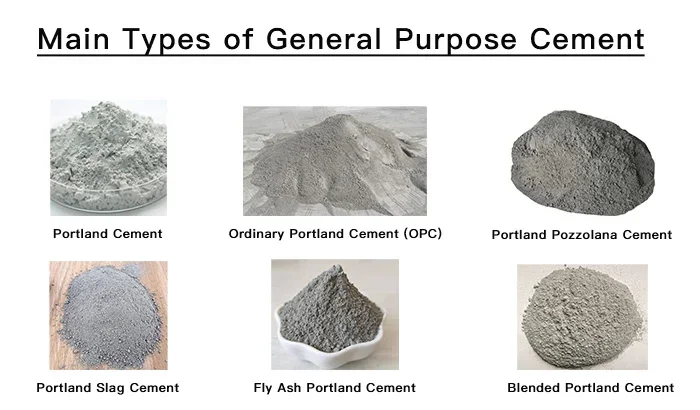
Among these, Portland Cement, Ordinary Portland Cement, Portland Pozzolana Cement, Portland Slag Cement, and Fly Ash Portland Cement are often referred to as the “Five Major Cements” in construction. Blended Portland Cement is also widely used and considered one of the common cement types.
3. Wall Putty Composition – Fly Ash
Some fillers in wall putty composition do more than just fill space; they also participate in chemical reactions that enhance putty performance. These fillers are known as active fillers. Examples include fly ash, silica fume, zeolite powder, and carbide slag powder, with fly ash being the most commonly used.

(1) Key Benefits of Fly Ash in Wall Putty
Fly ash, as an active filler, provides several advantages:
• Low Cost – Even the highest-grade fly ash (Grade I) is as affordable as low-cost fillers like heavy calcium carbonate. This is mainly because fly ash is a recycled industrial byproduct.
• Cement Savings – Fly ash can undergo a hydration reaction when activated by components in the material or by calcium hydroxide from cement hydration. This reaction produces a gel-like substance, reducing the need for cement and lowering production costs.
• Improved Strength Balance – Fly ash develops strength gradually, which helps balance the strength and sandability of the putty film.
• Spherical Particle Shape – Most fly ash particles are smooth, hollow glass spheres with a hard outer shell. This makes fly ash absorb less water and function like ball bearings, reducing the amount of mixing water needed (lower water-to-cement ratio) while improving workability.
(2) Technical Characteristic
Table 1-3 shows the requirements of GB/T1596-2005 on the performance of Class I fly ash.
Table 1-3 Quality Requirements for Fly Ash
| No. | Item | Grade I Fly Ash Performance Index |
| 1 | Fineness (0.045mm sieve residue) /% | ≤12 |
| 2 | Water Demand Ratio /% | ≤95 |
| 3 | Loss on Ignition /% | ≤5 |
| 4 | Moisture Content /% | ≤1 |
| 5 | Sulfur Trioxide (SO₃) Content /% | ≤3 |
(3) Application of Fly Ash in Wall Putty
Typically, fly ash is added to putty as a mineral filler with certain hydraulic activity. Its primary role is as a filler while also enhancing specific functional properties. However, in some cases, fly ash is used as the main raw material for making putty. Table 1-4 provides an example of such an application formula.
Table 1-4 Example Formula Using Fly Ash as the Main Raw Material
| Raw Material Name | Dosage (mass fraction)/% | Raw Material Name | Dosage (mass fraction)/% |
| Commercial Fly Ash | 70~90 | Redispersible Polymer Powder | 1~3 |
| Pozzolanic Active Filler | 10~20 | Methyl Hydroxyethyl Cellulose (MHEC) | 0.2 |
| Ordinary Portland Cement (42.5 Grade) | 6~12 | Defoaming Agent | 0.1 |
| Composite Expanding Agent | 1~5 | Antifungal Agent | 0.1 |
4. Wall Putty Composition – Wood Fiber
In wall putty composition, especially for paste-type exterior putty, flexible putty, or elastic putty, wood fiber plays an important role.
Wood fiber mainly helps improve the tensile strength and drying performance of putty. The drying aspect is particularly crucial because these types of putty have poor breathability. When the surface dries and forms a film, it can slow down the drying process of the inner layers.

(1) Basic Characteristics
Wood fiber, also known as functional engineering cellulose, is a natural fiber that is chemically inert and non-toxic. It is widely used in interior and exterior wall putty, waterproof coatings, textured coatings, and lightweight construction paints. It helps prevent cracking, provides thixotropic properties, and enhances thickening. Its key characteristics include:
Lightweight and highly porous – Provides excellent insulation, soundproofing, and breathability.
Flexible and strong – Forms a three-dimensional network when mixed, improving stability, strength, and uniformity of the material.
Chemically stable – Has a neutral pH, does not dissolve in water, solvents, weak acids, or alkalis, and enhances corrosion resistance.
Prevents shrinkage and expansion – Helps keep the putty mixture stable, reducing material deformation over time.
Improves drying uniformity – Its capillary effect ensures even drying, while maintaining breathability and moisture retention.
Enhances paint performance – Improves leveling, reduces dripping, increases coverage, strengthens the wet film, and creates a breathable, soft-reflective, crack-resistant, and durable coating.
High-temperature resistance – Provides strong protection against heat and cold. It can insulate for several days at 150°C, several hours at 200°C, and even withstand 220°C for a short time.
(2)Typical Technical Performance of Products
Table 1-5 lists the technical properties of a natural wood fiber
Table 1-5 Technical properties of natural wood fibers
| Product Model | Appearance | Fiber Content /% | Loose Thickness /(g/dm³) | Drying Loss /% |
| F – 3000 | Grey fibre | about 80 | about 20 | about 6 |
| 1004 – 1 | Grey fibre | about 85 | about 25 | about 5 |
| 500 – 1 | Grey fibre | — | about 90 | — |
| 1000 | Grey fibre | about 99.5 | about 60 | about 5 |
This article explains the common wall putty ingredients, such as redispersible polymer powder, cement, fly ash, and wood fiber, each playing an essential role.
However, for waterproof putty or certain special types of putty, additional unique ingredients are needed to meet specific performance requirements. For example, adding a water repellent to exterior wall putty gives it excellent water resistance, effectively preventing water from seeping into the wall and significantly improving waterproofing. This keeps the wall dry even in rainy or humid conditions.
Moreover, putty used in special environments, like high temperatures, high humidity, or areas with chemical corrosion risks, may require other special additives. In high-temperature environments, heat-resistant materials might be added to prevent cracking or peeling. In areas with chemical corrosion risks, anti-corrosion agents are included to enhance the putty’s resistance to chemical damage, protecting the wall from harmful substances.

In the actual production and application of wall putty, it’s crucial to carefully adjust the proportions of ingredients and add special components based on different usage scenarios and performance needs. This ensures the production of wall putty products that meet diverse requirements, providing a solid foundation for building decoration, maintaining wall quality and appearance, and extending the wall’s lifespan.

Posted by Isabel leave words
Hi, I've been in this industry for five years. I hope you enjoyed my blog. Welcome to leave a comment down below.
Leave a Reply