
 Send Your Inquiry
What Is EIFS in Construction? A Complete Guide
EIFS (pronounced eefs), is acronym of Exterior Insulation and Finishing System. It is also known as ETICS (External Thermal Insulation Composite Systems).
In North America, it is commonly referred to as EIFS. People regard the aesthetic decoration and system integration as more important. While in Europe, it is generally called ETICS. They highly value its continuous insulation layers and mechanical fastening.
Whether it is EIFS or ETICS, their components and functions are basically the same. Both are an integrated exterior wall construction system.

What Is EIFS in Construction?
Houses can provide shelter from wind and rain, but are hard to maintain a comfortable temperature throughout the year. EIFS makes insulated houses possible. EIFS places the insulation and heat insulation system on the exterior of the wall, just like giving the building a warm coat.
Currently, EIFS system has become the mainstream external wall insulation solution worldwide. It is widely used in new and renovated residential and commercial buildings. This system has many advantages:
1. It keeps the building in the same temperature environment. Avoid deformation of the building structure caused by temperature differences. Extend the building’s lifespan.
2. The external insulation layer wraps around beams and columns where thermal bridges are easily formed. Heat loss can be reduced. Room temperature keeps stable.
3. External insulation is easier to control wall cracks than internal insulation. It not only prolongs the building’s lifespan but also improves the waterproof function of the wall.
4. Wide range of applications. This system is not only suitable for cold regions but also for warm regions. Not only suitable for new buildings but also for energy-saving renovations of old buildings.
5. The external insulation is done on the exterior of the wall, not occupying indoor space. It saves the usable area of the house.
6. External wall insulation is economical. It reduces energy consumption for heating in winter and cooling in summer. It can recover energy saving and maintenance costs within 1-3 years.

EIFS Installation
EIFS installation must be carried out by professionals. Many EIFS problems arise due to improper construction.
Prepare the surface
Assess the flatness and suitability of the wall. If it is for an old substrate, the substrate should be first renovated. Clean the dust and oil stains, install base profiles and expansion joints. Check the verticality of the wall and mark the position for fixing the frame.
Attach the insulation board
Apply adhesive mortar on the back of the insulation board (in dots or in a full coat). Attach the insulation board from bottom to top. After 24 hours of standing, at least 4 anchor bolts should be nailed on each insulation board to prevent it from falling off.
Apply the facing protective layer
Thinly coat about 2mm on the surface of the insulation board, then attach the mesh fabric. Apply a second coat with a thickness of 3-5mm, covering the mesh fabric completely to ensure a smooth wall surface. Allow natural curing for at least 7 days.
Apply the primer
Seal the pores of the wall, avoiding later finish peeling or fading.
Do the finishing
Do a paint finish or a real stone paint finish.
EIFS Facade
Main Components of an EIFS System
EIFS is a integrated system, consisting of specific components, rather than a common general product made of separate materials. The two pictures below demonstrate its internal structure layer by layer.
EIFS Layers

🔘 Insulation Board
It is the core component of EIFS. Usually made of EPS expanded polystyrene board or XPS extruded polystyrene board. It can be either adhered to the wall or mechanically fixed. It is used to insulate and reduce thermal bridges.
🔘 Adhesive Mortar
The bonding mortar is usually a polymer-modified type. It is specifically designed to firmly attach the insulation board to the wall base. It can be applied in the form of dots, strips, or a full coating to ensure that there are no gaps when the insulation board is attached.
🔘 Base Coat
It is usually made of polymer cement, directly applied on the outside of the insulation board. It is used to adher the mesh fabric, making the entire insulation system more sturdy and resistant to wind and sun exposure.
🔘 Reinforcing Mesh
The alkali-resistant glass fiber mesh should be embedded in the base slurry for plastering. This can significantly enhance the wall’s resistance to cracking and impact.
🔘 Finish Coat
The finish layer is the outermost textured coating, such as synthetic plaster or elastic paint. You can choose colors and create textures to make the exterior wall look nice. Also it can resist ultraviolet rays and water, protecting the wall surface.
Types of EIFS
According to the binder system used in the bonding and base coat layers, EIFS can be classified into PB type (polymer-based) and PM type (polymer modified). You can easily get their difference from below chart.
| Types | Full Name | Characteristics | Common Applications |
| PB EIFS | Polymer Based EIFS | ▪️The main component is acrylic polymer. ▪️It has good flexibility and toughness, and is suitable for various substrates. ▪️PB type is currently the most common type of EIFS on the market. | Conventional building facades; Ordinary residential areas |
| PM EIFS | Polymer Modified EIFS | ▪️The insulating mortar is based on cement and is mixed with polymer modifiers (such as VAE/RDP). ▪️It has extremely strong impact resistance and better fire resistance. ▪️The plaster layer is much thicker than that of the PB system. | Places with a large flow of people and prone to collisions; High-rise buildings with exterior walls that are prone to impact |
Although PB EIFS is the most commonly used system, PM EIFS is able to take more challenges. It can’t be substituted with PB EIFS under specific working conditions. Such as the projects that needs higher impact resistance, fire performance, and long-term mechanical strength.
Therefore, PM EIFS is widely recognized for its superior mechanical performance. This largely depends on the use of polymer-modified mortar.
Why PM (Polymer-Modified) Mortar Is Essential in EIFS?
German John Schulz conducted a systematic study. When the content of VAE powder was 3.7%, the bonding mortar’s bonding strength could reach 2.3 MPa under 28-day curing conditions. Moreover, the dispersibility of the polymer dry powder was excellent, and it could be fully dispersed in the mortar within a very short time.
The long-term performance of the polymer dry powder was also very stable. The bonding strength was tested for 10 years in the experiment, it did not decrease but showed an increasing trend. The bonding strength of the polymer dry powder met the strength requirements for the finish with many bases, such as polyvinyl chloride (PVC), steel plates, wood boards, and ceramic tile surfaces.
These results demonstrate how the polymers in PM EIFS work and bring PM EIFS function to a higher performance. These also prove that PM EIFS has superior bonding strength and toughness compared to PB EIFS. Behind the performance of PM EIFS is the proper design of polymer additives.
Key Additives Used in PM EIFS Mortars
Role of RDP
It can make mortar and insulation boards (such as EPS boards) stick more tightly.
RDP can make the mortar structure more solid and its texture more flexible. Whether the bonding mortar layer, the reinforcing layer of the plastering slurry, or the decorative layer (such as decorative mortar, putty, tile adhesive, or sealant), it all contains redispersible polymer latex powder.
Role of Cellulose Ether
Ensure the cement does not dry out.
The PM system is usually applied very thinly. Cement hydration requires water. If the water is quickly absorbed by the dry air or by the substrate (insulation board), the cement will not be able to fully harden, resulting in powdering and cracking. Cellulose ethers can lock in moisture like a sponge. When added, the mortar is smooth and does not stick to the trowel.
Role of Starch Ether
It is a kind of lubricant. That makes the mortar smoother and easier to shape.
Starch ethers are usually used together with cellulose ethers. When attaching thick extruded boards or rock wool boards, starch ethers can provide better initial grip to prevent the boards from sliding.
Role of Fiber
Physical crack resistance. Prevent shrinkage cracks.
Do not confuse it with Reinforcing Mesh. The fibers are mixed within the mortar and are distributed in a three-dimensional random direction (such as PP fiber mesh). Especially in seasons with large temperature differences, its effect will be proved, and it will effectively prevent micro-cracks.
Customer Real Case: Adhesion Performance with WOTAIchem™ T5045N RDP
The following case is a sample test conducted by the Lithuanian customer of WOTAIchem™ using our RDP (Redispersible Polymer Powder) product. The test results were extremely successful!
Customer type: Agent
Product requirement: RDP
Application: ETICS exterior wall insulation system
Benchmark product: A company of Switzerland, product model FX 2320
Competitors: A company from China, product N515
Customer requirements: Pass deformation tests for ETICS. The customer emphasized the deformation tests particularly.
Sample recommendation: Based on China’s industry experience, WOTAIchem’s RDP T5043N is generally used for ETICS applications. However, considering the customer’s focus on deformation tests and the benchmark against Switzerland brand FX 2320, our product RDP T5045N can meet their requirements. Therefore, we sent samples of both RDP T5043N and T5045N to the customer for testing.
Sample testing process:
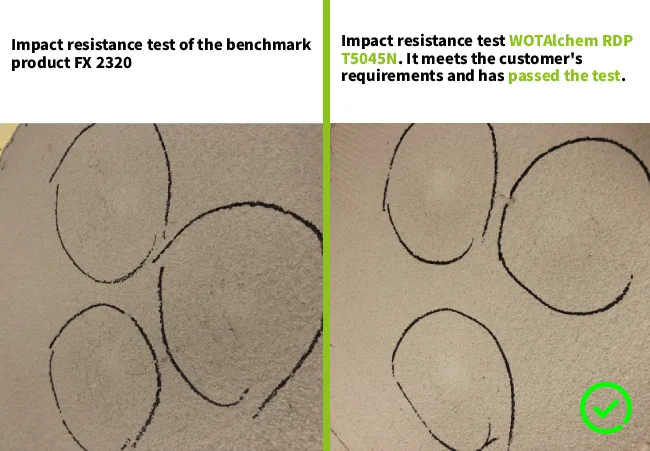
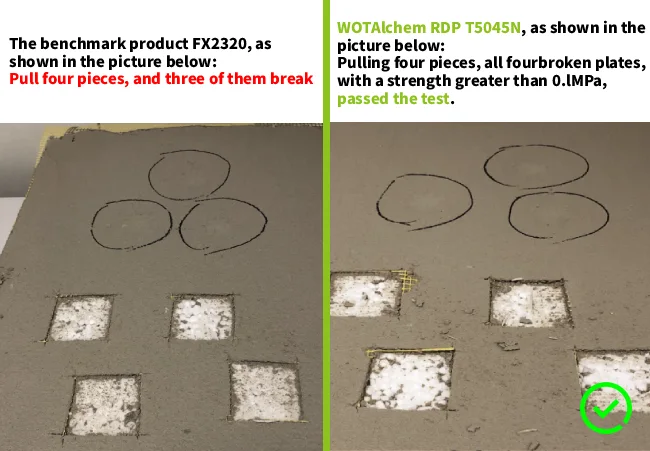
① Customer testing method: The customer is testing the adhesion of white and grey EPC (insulation materials) and conducting deformation tests using balls. Testing period: 28 days.
② Test results: The peer product N515 failed the test, RDP T5043N failed the test, while RDP T5045N passed the test.
WOTAIchem Additive Solutions for EIFS / ETICS
When it comes to EIFS/ETICS (External Wall Insulation System), people might first think of insulation boards. However, in reality, what truly determines the lifespan and appearance of the exterior wall is the chemical formula.
At WOTAIchem, we do not merely offer a single additive. What we provide is a complete set of core solutions to enhance the stability of the exterior wall system.
✅ Solving the bonding problem: Our RDP (Redispersible Latex Powder) is specifically designed for EIFS/ETICS. It enables your adhesive to be as firmly attached to the EPS or XPS board.
✅ Improving the construction feel: Our HPMC (Cellulose Ether) and MHEC have excellent water retention properties. They can ensure the mortar does not dry out or crack even in hot weather.
✅ Meeting the needs of different systems: Whether a PB system or a PM system, we have mature formulas to support you. No matter the basic EPS adhesive or the core Base Coat, WOTAIchem’s products can comprehensively enhance the EIFS system’s crack resistance, weather resistance, and waterproofing.
Conclusion
Regarding the EIFS/ETICS project, if you have any questions, please feel free to contact the WOTAIchem team at any time. We have a wealth of success cases. Our Lithuanian customer mentioned above is just one of these. You can fully trust our professional!
Feel free to send your questions. The email address below is supervised by dedicated personnel each day. Your email will be taken seriously and a clear reply will be given within 24 hours.

Posted by Isabel leave words
Hi, I've been in this industry for five years. I hope you enjoyed my blog. Welcome to leave a comment down below.
Leave a Reply