
 Send Your Inquiry
What Causes Foaming in Wastewater Treatment Plants?
During the wastewater treatment process, there’re always white foam and brown foam produced. How do these foams come about? Today Yuanwang™’s chemical engineer Isabel, will explain details on what causes foaming in wastewater treatment plants.

1. Foam Causes in Wastewater Treatment
1.1 Causes and Types of Foam
During the wastewater treatment process via activated sludge method, the foams produced can generally be classified into the following four types:
Foam during the start-up period
In the early stage of starting the aeration tank, the sludge is not yet adapted to the wastewater environment and grows slowly. Thus, the sludge content in the tank is low, while the wastewater treatment volume is large. This results in a high sludge load, and foams are easily produced. But this form will gradually decrease as the sludge content increases.
Denitrification foam
In an environment lacking oxygen or completely without oxygen, wastewater undergoes denitrification for nitrogen removal. Denitrifying bacteria convert two substances – nitrate nitrogen and nitrite nitrogen in the water into nitrogen gas. The bubbles formed by the nitrogen gas will carry some of the sludge to the surface, thus creating foam.
Surfactant foam
This kind of foam generally comes from the wastewater from washing and kitchen activities. This wastewater often contains sulfonic acid and fatty acid surfactants. These substances have a hydrophilic polar group at one end and a hydrophobic non-polar group at the other.
Under the action of aeration, the hydrophobic non-polar groups insert into the aeration bubbles, while the hydrophilic polar groups adsorb onto the surface of hydrophilic substances, and then convert the surface of hydrophilic substances into hydrophobic ones.
At the same time, they adsorb onto the water film surface of the aeration bubbles. Together with the sludge, through the aeration bubble’s air flotation effect, they float to the surface to form foam. This is called surfactant foam. This type of substance can make the foam more stable and more difficult to remove.
Biological foam
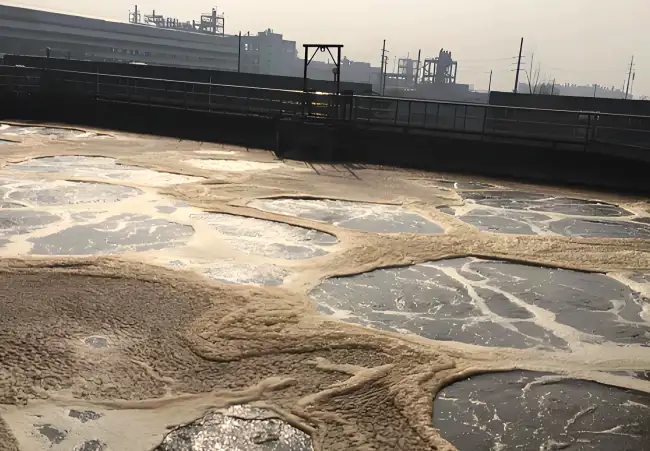
This is the most common type. The sludge contains lipid microorganism, some are filamentous and some are branched. Approximately 12% of these microorganisms are lipids. These lipids have a lower density than water and are insoluble in water. So they easily float on the water surface.
Studies have shown that actinomycetes and filamentous bacteria are the main species that produce white foam. When these two types of bacteria grow faster than ordinary bacterial flocs, their filamentous structures wound into a network, and wrap around the surface of the bubbles, protecting them from breaking, thus forming stable white foam.
1.2 Conditions for Foam Formation
Wastewater treatment results in foam formation. Why? This is related to the process, inflow water quality, and environmental conditions. There are 7 main influencing factors as follows:
1. Water temperature
When the water temperature is suitable, the microorganisms in the foam will multiply rapidly, leading to the formation of biological foam. The suitable temperatures for different strains of bacteria also vary.
For example, actinomycetes grow fastest at 20°C to 30°C. So in summer, when the temperature is high, actinomycetes are the main cause of foam formation. While a certain filamentous bacterium grows best at 12°C to 15°C. So in winter, when the temperature is below 15°C, this bacterium is the main cause of foam formation.
2. pH value of wastewater
Filamentous bacteria and actinomycetes grow fast at a pH value of 7 to 9, making the biological foam formed easily. However, if the pH value is below 6, these bacterial species cannot survive, and the foam will significantly decrease.
Therefore, adjusting the pH value of wastewater can effectively reduce foam formation.
3. Dissolved oxygen in water
Aerobic bacteria such as actinomycetes can multiply fast and form foam when there is a lot of oxygen in the aeration tank. While some filamentous bacteria will use nitrate in the water to multiply in anoxic or anaerobic conditions, also creating conditions for foam formation.
4. Sludge retention time
These microorganisms that cause foam formation grow slowly and have long life cycles. The longer the sludge stays in the biochemical tank, the more time they have to multiply, and the more foam is produced. Many wastewater treatment plants have found that when the aeration time is extended, the amount of foam increases.
Moreover, once a large amount of foam is formed, the sludge retention time cannot control these microorganisms, and the foam will accumulate and remain in the tank, so controlling the sludge retention time is particularly crucial.
5. Aeration method
Aeration equipment generates microbubbles, small bubbles, and large bubbles. Research has found that the smaller the bubbles, the more likely foam will form. Also, in areas with low aeration intensity, more foam will be produced.
6. Influent load
For the filamentous bacteria, they grows well at low temperatures. They can multiply regardless of the load level as long as the temperature is low. However, for the actinomycetes, they only multiply rapidly and form foam when the influent load is high.
Research shows that for the wastewater treatment plants with high influent loads, the probability of foaming is twice that of a low load.
7. Process operation speed
If the wastewater treatment speed is slow, the sludge will multiply and form clumps. At the same time if the influent flow is small, it is very suitable for the actinomycetes and filamentous bacteria growth, and foam will follow. Therefore, controlling the influent flow and treatment speed is very helpful in suppressing foam.

2. Foam Endanger in Wastewater Treatment
Foam in wastewater treatment mainly has the following 3 hazards:
First, foam is harmful to the equipment. It can let the equipment system to issue incorrect instructions can can’t be used normally.
Second, foam can cause harm to the surrounding environment. In summer, the temperature is high, some of the foam will emit a pungent odor, causing severe damage to the environment. In winter, the biological foam is prone to freezing, and the removal of frozen foam is extremely difficult.
Third, foam can affect the removal efficiency of pollutants in wastewater. When using aeration equipment, the viscosity of the foam itself will reduce the mass transfer rate and content of oxygen in the biochemical tank. It weakens the efficiency of pollutant treatment.
3. How to Control Foaming in Aeration Tank
3.1 Spraying water to break the bubbles
This is the simplest physical method. Using high-pressure water to break the bubbles on the surface. This causes the sludge adhering to the bubbles to disperse, and sink back into the biochemical tank. This method can eliminate a portion of the foam.
Placing the water spraying device in the aerobic tank can also continuously eliminate the foam. Although this method cannot solve the foam problem fundamentally, it is simple to operate and has low costs. Sewage treatment plants often use it.
3.2 Shortening sludge residence time
The actinomycetes and filamentous bacteria in the sludge grow slowly and have long cycles. Adopt a biological screening method to reduce the residence time of the sludge in the biochemical tank.
In this way, before these foam-producing bacteria grow in large numbers, they will be discharged outside the tank. This method can effectively inhibit the generation of biological foam at the source.
3.3 Adding carriers to the aeration reactor
Place suspended or fixed fillers in the aeration tank. This allows the activated sludge to attach to the fillers and grow. This not only effectively inhibits foam but also prevents sludge bulking, increasing the sludge volume in the tank. In turn, it improves the efficiency of wastewater treatment.
3.4 Integrated defoaming device
The device consists of an intake device, foam storage tank, drug addition device, and dehydration device. During operation, the intake device is suspended on the foam with a float. Use a pump to suck the foam into the storage tank. Then, it is mixed with PAM chemical agent in the tank for coagulation and sedimentation. Send to the dehydration equipment for dehydration. Finally, a sludge cake is formed, and the foam is removed.
After adjusting the parameters, it was found that when the PAM dosage is 0.6%, the moisture content of the dehydrated sludge cake can be controlled within 80%. These sludge cakes can be further treated in the ordinary way.
This device is both economical and effective. The annual cost savings for the sewage treatment plant due to this alone is 200,000 RMB. It is suitable for large-scale and regular foam treatment. To achieve a dual effects of quick foam removal and thorough treatment, Yuanwang™ experts recommend that use high performance defoamer.
3.5 Adding special anti-foaming agent
Adding special anti-foaming agents is an efficient way to treat industrial wastewater. As an expert in the defoaming industry for 11 years, Yuanwang™ deeply understands your pains such as recurring foaming, poor emulsification effect, and clogged equipment.
Through many years partnership with sewage treatment plants and papermaking enterprises, Yuanwang™ has reached a clear conclusion that high performance silicone defoamer has high reliability in defeating various kinds of foam.
One of our customers from Russia has proved this point. They are a paper factory. They faced a problem that the residual concentration of the slurry is high, and severe foaming continuously existing in the terminal wastewater tank. Moreover, the foam overflows frequently, leading to production disruptions and increases operational risks. The defoamer they used at that time reacts slowly and cannot prevent secondary foaming.
(👉 Learn more about how to choose the right defoamer for different systems)
They then contact Yuanwang™ professionals. Our team provides a highly efficient silicone defoamer specially designed for pulp-rich wastewater. Their sample testing yielded excellent results. The foam collapsed within minutes after deformer dosing, not re-foaming for hours. To this day, they have been using our products consistently and have never experienced foam overflow yet. Their production has since run smoothly and uninterrupted.
Feel free to contact us for a customized plan or an efficient defoamer for your wastewater treatment plant. We also provide free samples and professional technical support to precisely solve your foam problems.
(👉 If you are interested in how our defoamer works, read this Defoamer Mechanism for more information.)

Conclusion
To thoroughly solve the foam problem and reduce its volume, firstly, it is necessary to identify the causes of foam formation. Then analyze the related influencing factors. Finally, determine appropriate solutions and control measures.
For instance, if the sludge retention time is too long, resulting in biological foam, shorten the sludge retention time and inhibit the growth of microorganisms in the foam. In this way, there will be much less foam.
If you’re struggling with persistent foaming issues in your wastewater treatment plant or paper mill, get in touch with Yuanwang™ today. Contact via [email protected] and our chemical engineer can provide one-on-one guidance timely!

Posted by Isabel leave words
Hi, I've been in this industry for five years. I hope you enjoyed my blog. Welcome to leave a comment down below.
You’ve got a good understanding of waste water management as well as deep insights in the process for foam control and the ways and means of solving it Thanks.. appreciate your inputs
Thanks!
Leave a Reply