


Defoamer for Paper Industry
Papermakers have been working hard to fight against foam. The foam problem arises due to the use of pulping materials, cellulose and various chemicals. If the foam is not handled appropriately, it can cause unnecessary complications in later processing stages.
At this time, pulp and paper defoamers begin to demonstrate their critical roles. They make a great contribution to preventing and reducing foam in the pulping and papermaking processes.
Yuanwang Company offers different defoamers tailored to various stages of foam generation, from pulping to wastewater treatment stage. Our product range includes:
– Silicone-based defoamers
– Fatty alcohol defoamers
– High-carbon alcohol defoamers
– Mineral oil defoamers
How to Control Foam in PaperMaking?
There are two common ways to combat foam in the paper industry: physical and chemical defoaming.
Physical defoaming uses barriers or filters to trap foam. Then, it stirs, freezes, heats, or uses steam. These methods help break down the foam by speeding up how gas escapes and making the foam less stable.
Chemical defoaming means adding chemicals that react with the foam. This reduces the surface tension and causes it to break. In most cases, a defoamer for paper industry is used to quickly get rid of foam during paper production.
Yuanwang’s defoamer for paper industry has major benefits. In addition to foam inhibition ability, our company’s paper defoamer also has high-temperature resistance, strong acid and alkali resistance, and other excellent properties. With long-lasting foam suppression, they help manufacturers reduce costs and increase operational efficiency.
Paper Defoamer Product Details
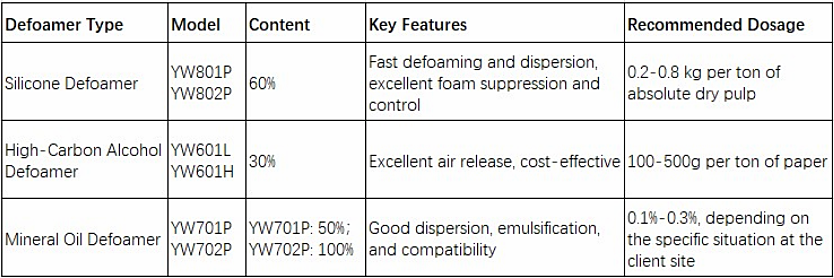
Yuanwang offers a range of anti-frothing agents for various foaming issues across industries. We offer silicone-based, high-carbon alcohol, mineral oil, fatty alcohol, and polyether defoamers. Each with unique formulations for specific processes. Please see the table about the main defoamers for the pulp and paper industries.
Why Choose Us
 Certifications
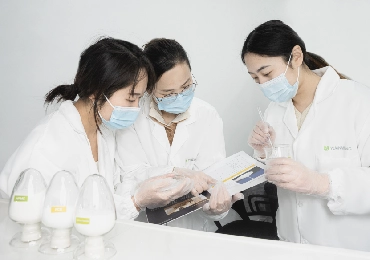
Yuanwang is ISO9001 certified. We also hold ISO14001 certification, demonstrating our commitment to environmental sustainability. ISO45001 shows our commitment to a safe, healthy workplace for our employees.
 OEM Solution
We offer a wide range of defoamer products, fully customized to meet the specific needs of our clients. Our OEM solutions offer flexible options. They ensure each product meets the unique needs of various industries.
 Production Capacity
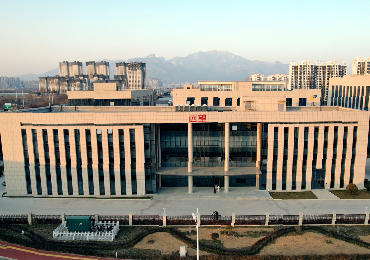
Yuanwang has 5 large production bases in China. We can make up to 20,000 tons of defoamers annually. Business products involve many fields. Our strong production capacity lets us meet local and global demand.
 State-Owned Enterprises (SOE) Background
Yuanwang, a state-owned enterprise, enjoys government support and stability. This background lets us ensure high quality and efficiency. It guarantees our clients’ long-term reliability.
Pulp Mill Defoamer Supplier

Defoamer for Pulping Section (Brown Stock Washing, Black Liquor)
During the pulping process, foam often forms in brown stock washing process. The black liquor produced during washing also creates foam. To deal with foam at both of these stages, pulp defoamer should be added.
Silicone-based defoamers are widely used to kill pulp foam. They are effective, based on actual industry use.
Defoamer for Papermaking (White Water Pool Process)
The paper defoamer, also called pulp mill defoamer, removes air from the foaming medium before breaking the foam.
Fatty alcohol defoamers, such as high-carbon alcohol defoamers, are commonly used for this purpose.


Defoamer for Paper Coating
Foam during paper coating is caused by the use of alkaline agents, pigments, and the preparation of coating materials. This foam can affect the efficiency of coating operations and the quality of the paper.
Brown stock washing silicone defoamer also effective in the coating process. It ensures the formation of a smooth, flat, and uniform coating surface, especially for the production of coated paper.
Wastewater Treatment Defoamer
When foamy wastewater flows into the treatment pool, it can make the water come out unevenly and disturb the settling process.
Yuanwang’s defoamer for paper industry are specially formulated. They work well at very low temperatures and in highly concentrated wastewater.

Defoamer for Paper Industry
- Washing Pulp (Black Liquor)
- Papermaking (White Pool Process)
- Paper Coating
- Wastewater Treatment
The process of washing pulp generates foam in the black liquor. This is due to the constant circulation of surfactant in the continuous cycle. The alkali impacts, and the saponification of oil also stabilizes the bubbles.
The defoamer quickly removes foam in washing tanks and screening equipment. This improves waste liquid separation, keeps the pulp clean, and prevents downtime caused by frequent screen cleaning.
The water temperature of white water for papermaking ranges from room temperature to 60°C. In the circulating system, after impact and mixing, air is mixed into the white water to form foam. Some residual chemical auxiliaries added in the process form small bubbles in the white water, which can be dispersed stably in it.
In the pulp delivery system and wire section, the defoamer breaks foam fast, reducing defects like pinholes and spots. This ensures the paper surface is smooth and the sheet formation is uniform.
In addition to fillers, pigments must be added to the coating. These include dispersants, wetting agents, and other additives. These additives are surfactants. In the coating preparation process will lead to the generation of foam.
During coating machine operations, the defoamer eliminates foam to keep the coating layer even and defect-free. It provides quick defoaming, long-lasting foam suppression, and works well in high-speed coating processes.
Paper wastewater foam is caused mainly by surfactants in the paper raw materials and additives.
Yuanwang defoamer rapidly removes foam in aeration tanks and reactors, restoring oxygen transfer efficiency and microbial activity, which shortens the treatment cycle.
It adapts to different wastewater types and remains stable under harsh conditions like strong acid, strong alkali, and high temperatures, ensuring compliant discharge.
Related Products




Frequently Asked Questions
· Pulping (Washing Pulp, Black Liquor): Silicone-based defoamers
· Papermaking (White Water Pool Process): Fatty alcohol defoamers, such as high-carbon alcohol defoamers
· Paper Coating: Mineral oil defoamers
· Wastewater Treatment: Silicone-based defoamers
1. Antifoam agents must be added in advance. If you don’t do that and wait for the foam to appear then add it, the effect will be discounted.
2. Also, the white water system runs at 30-40 degrees Celsius. You must choose the right anti-foaming agent for this temperature.
3. Store and use the environment: defoamer should be in a dry, cool place, away from sunlight and heat.
1. Maintaining excellent continuous defoaming ability at a low additive amount
2. Excellent defoaming and foam-breaking properties
3. Quickly and thoroughly improve filter drainage
4. Help dehydration, and reduce the pulp water content, in order to reduce the energy consumption of the evaporation process
5. Good mutual solubility with black liquor, suitable for pulp mill production conditions
6. Reduce the amount of bleaching chemicals to benefit the environmental requirements.
 Contact Us