
 Send Your Inquiry
What Is the Composition of Making the Mortar?
In the old days, when ancient people wanted to build a house to shelter, they gathered bricks and stones, but had no idea how to make these scattered bricks stick together tightly and not be washed away by the wind and rain.
At first, they tried to apply wet mud to the gaps between the bricks. However, when the sun dried it, the mud cracked and fell off. Later, they tried to mix clay and wood ash. This method made the wall a bit stronger, but it would still become soft in the rain and the wall would gradually lean.
After much exploration, they finally found a secret recipe – mixing lime, clay and sand in proportion to make a thick paste and applying it between the bricks. Only then did the house become truly solid and durable.
This adhesive paste discovered by the ancients is mortar. Over thousands of years of evolution, the chemical composition of mortar has been continuously optimized, but the core basic materials have remained unchanged. Its formula has become more scientific.
Today, we will take a step-by-step look at what components are needed to make mortar and what roles different components play.
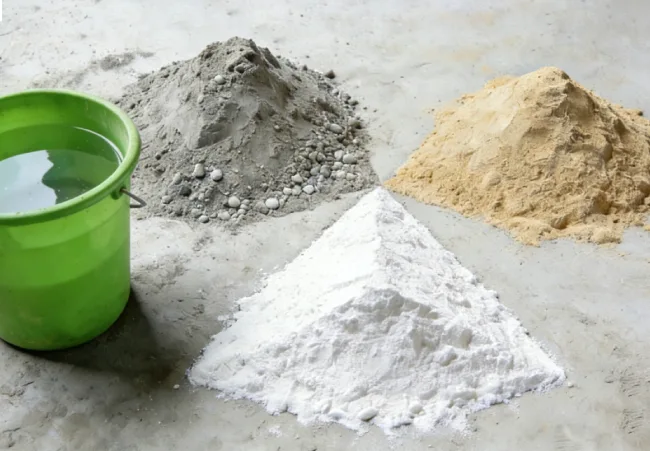
What is Mortar?
Mortar is also known as cement mortar. It is used in construction projects as an adhesive material. Its original purpose was to bond brick, stone, and block masonry materials, making them firmly integrated as a whole.
Nowadays, mortar uses are diverse. It is used for leveling, protecting, and decorating walls, ceilings, and floors, as well as for filling gaps and repairs. Modern mortars must have specific cementing materials and material ratios to meet strength requirements.
Mortar Types and Uses
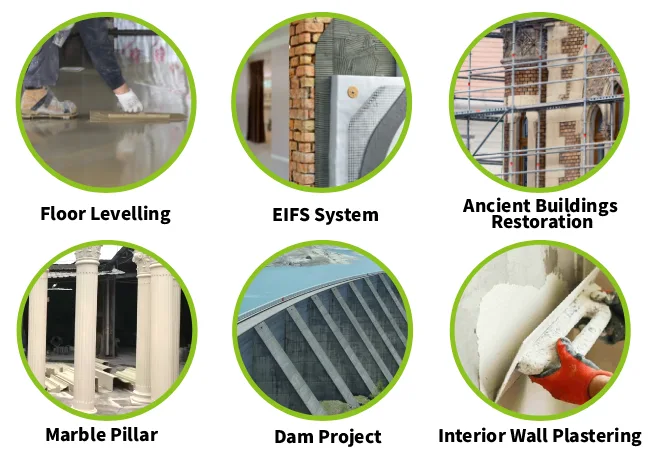
| Mortar Types | Key Composition | Characteristics | Uses |
| Ordinary Portland cement mortar | ▪️Cementitious material – Ordinary Portland Cement ▪️Fine aggregate – Sand ▪️Water | High strength, good durability and economical materials | General wall masonry and floor leveling |
| Polymer-Modified Mortar | ▪️Cementitious material (base material) – Cement ▪️Aggregate (filler) – Graded sand ▪️Polymer component (modifier) – Redispersible polymer powder ▪️Functional admixtures – Cellulose ether, etc. Water | It has extremely strong adhesion, good flexibility, is resistant to bending and cracking, and has higher durability | Ceramic tile bonding, external thermal insulation systems (insulation boards and surface protective layer adhesion), swimming pools and other places with high waterproofing requirements |
| Lime mortar | ▪️Cementitious material – slaked lime ▪️Aggregate (filler) – Sand ▪️Water | Good plasticity, excellent air permeability | Compatible with ancient building materials, and used for the restoration of ancient buildings. The breathable plastering of the interior walls of the museum. |
| Gypsum Mortar | ▪️Cementitious material – Gypsum ▪️Aggregate (filler) – Sand ▪️Water ▪️Retarder | It sets extremely fast, has strong plasticity and excellent fire resistance | Interior ceiling plastering, marble pillar and other decorative lines |
| Pozzolanic mortar | ▪️Basic Cementitious material – lime ▪️Core modifier – volcanic ash material ▪️Aggregate (filler) – Sand ▪️Water | Because it contains volcanic ash materials, this mortar can resist water erosion and even continue to increase its strength in water. | Underwater projects, such as the construction and restoration of seaports, bridge piers and dams |
| Mixed mortar (composite mortar) | ▪️Composite cementitious material – Cement & Lime ▪️Aggregate (filler) – Sand ▪️Water ▪️Admixtures – Superplasticizers or air-entraining agents | The mortar is smooth and full, with good workability, smooth construction and reduced shrinkage and cracking | Interior wall masonry in a dry environment Interior wall plastering General interior wall leveling for civil buildings |
| Special functional mortar | Basic mortar components & special admixtures (add as needed) ▪️Take waterproof mortar as an example, its composition: Cement, sand, redispersible polymer powder, silicone hydrophobic agent/calcium stearate, cellulose ether. ▪️For expansive mortar, its composition: Cementitious binder, fine aggregate, expansive agent, mineral admixtures ▪️Refractory mortar composition: Refractory aggregates, refractory powder, binders, mineral admixtures, chemical additives | Targeted function Outstanding performanceFor instance, Waterproof Mortar: crack-resistant and water-resistant Thermal Insulation Mortar: thermal insulation and heat preservation Self-leveling Mortar: high fluidity | ▪️Waterproof mortar for basements, bathrooms and water tanks. ▪️Thermal insulation mortar for internal/external wall insulation, roof insulation layer. ▪️Wear-resistant floor mortar for heavy-duty floors for garages, factories and warehouses. ▪️Self-leveling mortar for precise leveling of the floor before laying wooden floors or carpets. ▪️Anti-cracking plastering mortar for surface plastering for lightweight walls prone to cracking (such as aerated concrete blocks). |
The above classification is based on the composition of mortar. In the ASTM C270 standard, mortar is clearly classified according to the compressive strength of mortar, from high to low strength – type M, S, N, O, K.
28-day compressive strength from high to low: M > S > N > O > K. The higher the strength, the more suitable it is for load-bearing, underground and heavy loads. The lower the strength, the softer it is, and it is suitable for decoration and ordinary masonry on the ground.
| Mortar Types | Compressive Strength (psi/MPa) | Main Uses |
| Type M | 2500 / 17.2 | Heavy-duty walls, foundations, retaining walls, underwater structures, and structures below ground level |
| Type S | 1800 / 12.4 | Exterior wall load-bearing, anti-seismic structure, exterior wall, seismic resistance, high-rise |
| Type N | 750 / 5.2 | Most common uses: above-ground interior walls, exterior walls, facing tiles, and ordinary masonry |
| Type O | 350 / 2.4 | Non-load-bearing interior walls, restoration of old buildings, and lightweight decorative masonry |
| Type K | 75 / 0.5 | Ultra-light, non-load-bearing, historical building restoration (rarely used) |
What Is the Difference Between Cement, Concrete and Mortar?
Now we have understood the mortar types and uses, but you may have a question: is the mortar the same as cement and concrete? What exactly is the difference between mortar, cement and concrete?

Specifically speaking, the three are different things, and each has a specific job.
The bonding power of mortar relies on a key ingredient: cement. Cement is a powder obtained by burning and grinding limestone and clay. It has a special property – it slowly hardens when mixed with water. However, using it alone is completely useless. It either becomes too thin and flows away after adding water, or it hardens and becomes brittle and easily broken.
So mortar allows cement to be useful. Mortar mixes cement, fine sand, and water. It perfectly makes up for the defect of using cement alone. It retains the adhesive strength, yet becomes smooth and easy to work with.
Then, what makes concrete different?
A house needs mortar to lay bricks and plaster walls. But the hardness and load-bearing capacity of mortar are limited. Mortar cannot support the weight of a house——for example, the pillars and floor slabs that build the house.
This is when a material that is hard, strong, and able to withstand heavy pressure is needed. That material is concrete.
In the combination of cement, sand, and water, add uniformly sized, hard stones. Mix them evenly and pour them into a mold. After it completely hardens, this mixture becomes extremely hard. It can bear enormous weight and resist erosion from wind and rain. Even when used for a house’s pillars and floor slabs, it can firmly support the entire building.
In real life, when building a house, concrete is used first to cast the pillars and floor slabs (build the house’s skeleton). Then, mortar is used to stick the bricks together to build the walls. And cement is the core binding material that runs through the entire process.
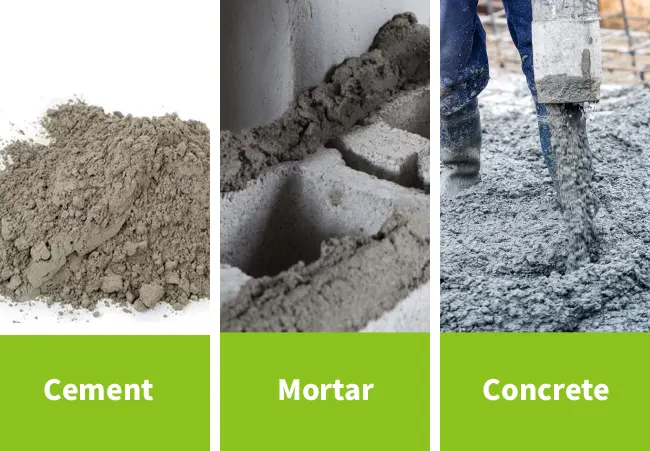
| Name | Main Components | Contains Gravel (Yes/No) | Characteristics | Common Uses |
| Cement | Cementitious materials ground from clinker into fine powder | No | Hardens when mixed with water, but is prone to cracking | Not used alone; primarily used to make mortar and concrete |
| Mortar | Cement + Sand + Water | No | Good bonding strength, limited load-bearing capacity | Laying bricks/blocks, plastering, leveling |
| Concrete | Cement + Sand + Gravel + Water (+ Admixtures) | Yes | High compressive strength, can bear significant loads alone | Beams, slabs, columns, etc. |
5 Main Functions of Mortar in Masonry
✅ Bonding effect: Firmly bond bricks and blocks together to form an integral wall. Ensures structural stability.
✅ Leveling and straightening: Fill in the unevenness during masonry, making the wall surface smooth, vertical and aesthetically pleasing.
✅ Uniform force transmission: Disperse the pressure from the upper part, making the force distribution more uniform and enhancing the integrity and strength of the wall.
✅ Sealing and insulation: Fill the gaps, reduce air permeability and water seepage, and enhance the insulation and heat preservation effect.
✅ Buffer protection: Reduce hard contact between bricks to prevent cracking and damage.
3 Common Issues/Questions When Using Mortar
1. Why does mortar crack after being applied?
Too high water-cement ratio and too much water is added. The mortar dries quickly, shrinks significantly and cracks as soon as it dries.
The base layer is too dry and no water is sprinkled to moisten the wall or ceiling. It will quickly absorb the water in the mortar, causing rapid shrinkage and cracking.
Applied the mortar too thickly at one time. The drying speeds inside and outside will be different, and the internal stress will crack the surface.
No proper maintenance. If water is not sprinkled after application, the cement will dry before it has fully reacted and is bound to crack.
Large temperature changes. Exposure to intense sunlight, strong winds, and alternating cold and heat can cause thermal expansion and contraction, cracking the mortar.
Incorrect proportion. If with too little cement and too fine sand, the strength is insufficient and it is prone to cracking.
2. Can new mortar be put on top of old mortar?
Sure, but three conditions must be met, otherwise, it will be 100% hollow and fall off.
1) The old mortar must be firm: any loose, sanding or powdering must be chiseled off completely.
2) The surface must be treated: roughened, dust removed, and interface agent/cement slurry applied.
3) Before construction, it must be moistened, but there should be no standing water, and then apply new mortar.
3. How to fix mortar cracks?
1) Cleaning: Chisel off all loose, hollow and sandy parts, and sweep away all the dust.
2) Moistening: Sprinkle water to moisten the base layer, but there should be no standing water.
3) Interface treatment: Apply a layer of cement slurry or interface agent to enhance adhesion.
4) Filling: Use mortar of the same strength to compact and smooth it in layers.
5) Maintenance: After repair, keep it moist for maintenance to prevent cracking again.

FAQs About Mortar
1. What is mortar additive?
Mortar additive is an agent to improve the performance of mortar. Its addition amount is usually small, but it can significantly change the key properties of mortar.
For instance, in plastering gypsum mortar, adding 0.1% to 0.15% HPMC additive can significantly improve the water retention of the mortar.
2. Why add lime to mortar?
1) After adding lime to mortar, the mortar will become smooth and full, making it feel easier to apply when plastering walls.
2) The addition of lime can reduce the rigidity of mortar and make it have a certain degree of plasticity.
3) Lime can slightly slow down the setting speed of cement and prolong the open time.
4) Lime is cheaper than cement. Under the premise of ensuring strength (such as low-strength grade mortar), replacing part of the cement with lime can reduce material costs.
3. What additives darken the colour of mortar?
Pigments (iron oxide black or carbon black).
Usually, 1% to 10% of the weight of cement can be added. The more pigment additive you add, the darker the color will be.
4. Does pva additive weaken mortar?
When the dosage of PVA (polyvinyl alcohol) is 0.6%, the compressive strength of the mortar can be increased by approximately 12%;
When the dosage of PVA (polyvinyl alcohol) is 1.0%, the breaking strength of the mortar can be increased by approximately 25%;
When the dosage of PVA exceeds 1.5% – 2.0%, the strength of the mortar decreases, which will weaken the performance of the mortar.
5. How much polymer additive for mortar?
For WOTAIchem™ redispersible latex powder used in tile adhesive, the recommended usage should not exceed 2%.
6. What does latex additive do for mortar?
WOTAIchem™ redispersible latex powder can make mortar adhere more firmly, enhance flexibility. The tensile strength of the polymer film is more than 10 times greater than that of ordinary mortar.
7. What are mortar additives for cold weather?
Antifreeze, early strength agent, air-entraining agent, water-reducing agent (eg. naphthalene superplasticizer)
8. What are waterproof mortar additives?
The common waterproof mortar additives are:
1) Silicone hydrophobic agent
2) Waterproofing agent
4) Polycarboxylate superplasticizer
9. What are the differences between on-site mortar mixing and ready-mixed mortar?
On-site stirring: flexible, low cost, unstable quality, relatively low efficiency, and generates a lot of dust
Ready-mixed mortar: dry mix mortar with precise formula, just add water and it will work. Uniform mixing, stable and controllable quality, and more environmentally friendly.

Posted by Isabel leave words
Hi, I've been in this industry for five years. I hope you enjoyed my blog. Welcome to leave a comment down below.
Leave a Reply