
 Send Your Inquiry
Tile Mortar vs Tile Adhesive: Which Has the Strongest Hold?
Before the 1960s, tile mortar was the primary material for tile laying. This method relied on thick-bed mortar applications. It required substantial material usage and skilled workmanship.
In the 1960s, Germany’s WACKER developed redispersible polymer powder, marking the birth of modern polymer-modified tile adhesive. This innovation significantly improved bonding performance and construction efficiency. That laid the foundation for a new era in tile installation technology.
Since then, thin paste method gradually replaced the traditional thick mortar paste. With the outstanding advantages of safer and more durable, tile adhesive is becoming more and more popular, and eventually becomes the mainstream choice of modern decoration.
Both mortar and tile adhesive can be used to stick ceramic tile, what is the difference between them? Today, WOTAIchem will discuss detailedly on tile mortar vs tile adhesive.

Tile Mortar vs Tile Adhesive – Composition
Tile Mortar
Tile mortar is mainly composed of cement, sand and water. When cement is mixed with water, a series of complex hydration reactions will occur, and gradually harden to form a solid with a certain strength.
For pure cement-based tile mortar, its bond performance is relatively simple, mainly rely on the mechanical bite force after cement hardening to fix the tile. In the face of a few more smooth surfaces and low water absorption of ceramic tiles, the tile mortar bonding effect is often unsatisfactory.
Tile Adhesive
Tile adhesive, also known as ceramic tile binder. It usually uses cement as the basic binding material, on which, a variety of polymer additives such as redispersible latex powder, hydroxypropyl methyl cellulose ether, wood fiber and starch ether are added, as well as finely screened graded sand.
▪️The redispersible powder can form a continuous polymer film after the tile adhesive is cured, which greatly enhances the bond strength and flexibility.
▪️Hydroxypropyl methyl cellulose ether plays the role of water retention and thickening, ensuring good operation performance of tile adhesive in the construction process, while improving the final solidification strength.
▪️Wood fiber can effectively crack, reduce the possibility of tile adhesive in the drying process of cracks.
▪️The addition of grading sand optimizes the particle grading of tile adhesive and enhances its filling performance and overall stability.
This diversified formula system makes tile adhesive have a more comprehensive and powerful ability in bonding performance.
Tile Mortar vs Tile Adhesive – Characteristics

Construction Convenience
Traditional cement and tile mortar materials have poor water retention. The construction process is rather complicated. Commonly, the wall surface needs to be moistened, tiles need to be soaked in advance, and the materials should be laid thicker.
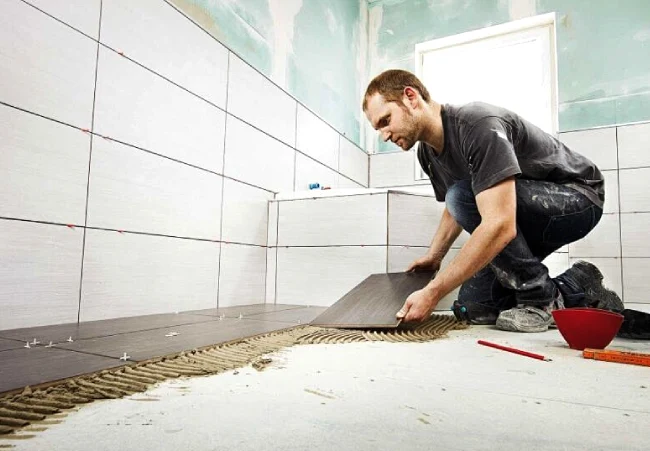
In contrast, the application method of tile adhesive is more convenient. Just add water in proportion and stir evenly. Then, use a toothed scraper to apply the paste on both sides and press it thinly. The tiles do not need to be soaked either, which saves time and labor costs for the workers and homeowners. It is about three times faster than traditional tile mortar construction.
Tiling Thickness
Tile mortar has poor water retention and a relatively high water absorption rate, so the thickness of tile mortar for laying is usually around 20mm.
Tile adhesive has good water retention and strong adhesion. It is used with a thin tiling process, with a thickness of approximately 5mm. Therefore, using tile adhesive saves more space.
Effect of Bonding
The bond strength of tile mortar is generally between 0.5-1.0MPa. The wall bricks that are pasted with tile mortar are easy to be pasted unevenly and have pores on the surface, which may lead to weak paste, empty drum and falling off ceramic tiles.
The bond strength of tile adhesive can easily reach more than 1.5MPa, and even the bond strength of some high-performance tile adhesive can exceed 2.0MPa. Uniform distribution, high full slurry rate, not easy to produce hollow drum, falling off and other phenomena.
Flexibility
Tile mortar: No flexibility, large shrinkage rate
Tile adhesive: It has good flexibility and can adapt to the slight deformation of tiles and the base layer
Weather Resistance/Durability
In the kitchen, bathroom and other areas that often touch water, the water resistance and durability of ceramic tile paving materials are crucial. Although the cement based tile mortar has some water resistance, some components of the cement may undergo hydrolysis reactions in a humid environment for a long time, and results in a decrease in strength. Moreover, there are many pores in the tile mortar, and water is easy to penetrate into it, which accelerates the aging and corrosion of the material.
The water resistance of ceramic tile adhesive is fully considered in the formulation design. The polymer additive can form a protective film on the surface of cement particles and effectively prevent the invasion of water. At the same time, the ceramic tile adhesive has a more compact microstructure and lower porosity, which further improves its water resistance and durability. After long-term soaking and dry-wet cycle test, tile adhesive can still maintain good bonding performance, to ensure the firmness of tile in humid environment.
Tile mortar: water resistance, weather resistance is general, wet environment easy to powder failure
Tile adhesive: water resistance, high temperature resistance, freeze-thaw resistance, aging resistance, long-term stable bonding performance
Transportation and storage
Tile mortar: cement and sand need to be interspersed, so they should be transported separately. Sand is generally stored in bulk outdoors, but also through the screening, so special attention should be paid to waterproof, windproof, labor time cost greatly increased.
Tile adhesive: once transported, indoor convenient storage.
Application
Tile mortar paste brick need to soak water in advance to use, such as glass brick because of its low water absorption, the use of tile mortar, even if the effect is still not ideal after the brick.
Compared with tile mortar, ceramic tile adhesive has stronger adhesion, better water retention and wider application range. Polishing brick, antique brick, Mosaic brick, especially the glass brick with low water absorption need ceramic tile adhesive with strong adhesion.
In China, the Ministry of Housing and Urban-Rural Development has banned tile mortar from sticking to exterior walls. In the catalogue, the finishing brick tile mortar paste process is listed as prohibited. It has be replaced by new binders such as tile adhesive and premixed materials.
Environmental protection
Tile mortar: Tile mortar site mixing, dust flying, poor construction environment, construction personnel and the environment caused a certain impact.
Tile adhesive: Ceramic tile adhesive can be used by mixing with water, the construction site is clean, reduces waste, and is more environmentally friendly.
Thin Set Mortar vs Tile Adhesive
Thin bottom mortar (thin set mortar) is a kind of thin leveling material specially used to make the wall and the ground flat. It is not used to stick ceramic tile, but used for base leveling before tile fixing.
✅ It belongs to leveling material, not bonding material.
✅ The thickness is generally very thin, so it is called thin bottom (thin layer).
✅ The main ingredients are cement, sand and additives, without the strong adhesion of tile adhesive.
✅ Function: smooth and vertical the wall/floor with potholes, and lay a good foundation for the tile in the back.
Which is Better for Backsplash or Shower: Tile Adhesive or Mortar?
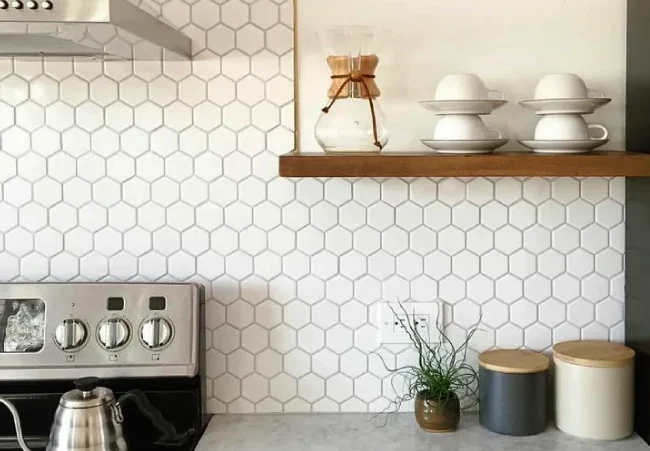
For backsplash (kitchen backsplash) and shower, always choose tile adhesive for the following reasons👉
1. Damp shower & kitchen backsplash
▪️ Tile adhesive (tile adhesive) contains polymer, resistant to water, moisture. It is still strong after long-term soaking water/wet environment.
▪️ Tile mortar is poor in water resistance, and it is easy to soften, powder and drop bricks in humid environment.
2. Brick walls are easy to slide down
▪️ Tile adhesive has good anti-slip, stable paste, not easy to slide and empty drum.
▪️ Tile mortar is too thin and thick to be adjusted manually. When applied to the wall, it is prone to sagging and not adhering firmly.
3. Most modern tiles do not absorb water
Now backsplash and shower commonly used porcelain, glass brick, marble, and their water absorption is very low.
▪️ Tile adhesive by chemical and physical double adhesive, firmly grasp.
▪️ Tile mortar will not stick and the empty drum will fall off easily.
4. Thin paste is more beautiful and does not take up space
▪️ Tile adhesive only needs 3 — 6mm, the wall surface is more flat.
▪️ Tile mortar should be thick, take up space, not beautiful.

Posted by Isabel leave words
Hi, I've been in this industry for five years. I hope you enjoyed my blog. Welcome to leave a comment down below.
Leave a Reply