
 Send Your Inquiry
Concrete Admixture: Your Top 5 Critical Concerns
During the process of mixing concrete, a type of chemical substance is added to improve its performance. This substance is called a chemical admixture of concrete, commonly referred to as a concrete admixture. Depending on the construction requirements, there are various types of admixtures in concrete.
Before diving into the details, let’s first take a look at what is admixture in concrete.
I. What is Admixture in Concrete?
Concrete admixtures are auxiliary materials incorporated into the concrete during its production. They are used to regulate and improve the performance of concrete.
II. Why is Admixture Used in Concrete?
Concrete is typically made by mixing cement, sand, gravel, and water, resulting in standard performance. However, different construction requirements demand specific properties in concrete. For example:
▪️Pumping processes require highly flowable concrete.
▪️Large-span structures demand high-strength and highly durable concrete.
▪️Winter construction necessitates early-strength concrete.
Without concrete admixture, it is challenging for concrete to meet these specific requirements. By using suitable types of admixtures in concrete, various properties of concrete can be enhanced, such as adjusting setting time, increasing strength, improving durability, reducing shrinkage, and meeting specific construction and environmental demands.
The choice of admixture should depend on the intended use of the concrete. Different admixtures are suited for various types of concrete and engineering environments. Keep reading to find out which admixture used in concrete is best suited for your construction conditions.
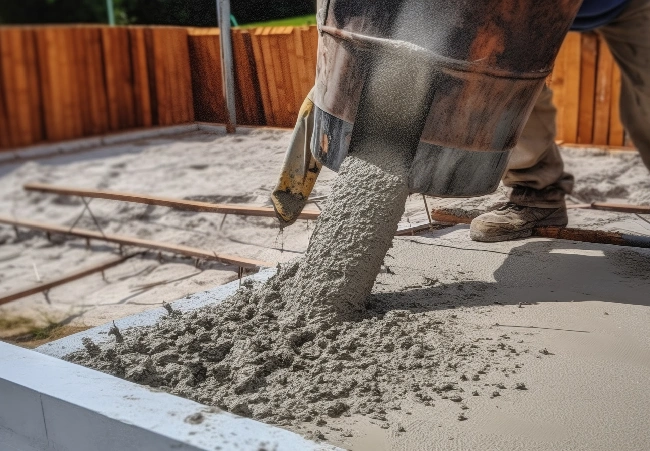
III. Best Admixture for Concrete
The best admixture for concrete depends on the specific application requirements and project conditions. See the table below for a detailed summary.
| Common Problems of Mixed Concrete | Recommended Concrete Admixture | How Admixture Works in Concrete | Representative Products |
|
Excessive water to concrete was added, and the strength and durability of the concrete were reduced. |
| 1) Reduce the water requirement of concrete mixtures; 2) Enhance concrete strength, improve the bond between concrete and steel reinforcement, and prevent issues like cracking, segregation, honeycombing, and bleeding. | Water-reducing admixtures, also known as plasticizers, are divided into three types: Plasticizers: Reduce water consumption by up to 10% Mid-range plasticizers: Reduce water consumption by up to 15% Superplasticizers: Reduces water consumption by up to 30% |
| During construction, uneven application on walls may occur, leading to issues such as material not adhering to surfaces, uneven spreading, and mud splattering. |
| Increase the consistency of the concrete paste, encapsulating free water within the mixture and improving its workability and flowability. | Methylcellulose, such as hydroxypropyl methylcellulose HPMC; |
| In high temperatures, concrete sets too quickly, causing discontinuities in the structure and creating unnecessary voids. |
| 1) Slow down the cement hydration process 2) Extend the setting time 3) Help fresh concrete retain its plasticity for a longer period. | Commonly used: calcium sulfate or gypsum. Other: Starch, cellulose products, such as HPMC, HEMC, etc. |
| In low temperatures, concrete takes longer to set, reducing construction efficiency and extending project timelines. |
| Accelerate cement hardening, enabling concrete to gain strength quickly and shortening the construction timeline. | Cheap and commonly used: calcium chloride. Others: Calcium formate, triethanolamine, sodium sulfate, etc. |
|
During cold winters, freezing water in concrete expands, causing surface cracks, and thin layers, and potentially damaging the concrete’s structure. |
Air-entraining admixtures | Create millions of tiny, non-coalescing bubbles throughout the mixture. This improves the workability, impermeability, freeze-thaw resistance, and crack resistance of the concrete | The most commonly used: rosin resins, fatty alcohol sulfonates, petroleum sulfonate hydrochloric acid, polyvinyl alcohol, etc. |
|
During the concrete mixing process, air can become trapped in the mixture, forming bubbles. These bubbles may result in surface pores, affecting the appearance and potentially leading to micro-cracks. |
| Break the surface tension of bubbles, causing them to quickly coalesce and disappear, thereby reducing the number of bubbles and increasing the density and strength of the concrete. | Polyether defoamer Silicone defoamer Fatty alcohol defoamer Mineral oil defoamer |
| In underwater concrete structures, the mixture is at risk of being eroded by underwater pressure, increasing the likelihood of structural issues. |
Anti-washout admixtures | Provide water resistance and durability, protecting the concrete mixture from erosion caused by underwater pressure and improving its cohesion. | It is prepared from natural or synthetic rubber, cellulose-based thickener, (rdp powder), etc. |

IV. What is the Code for Concrete Admixture?
1. IS 9103: 1999 CONCRETE ADMIXTURE – SPECIFICATION:
a) Accelerating admixtures
b) Retarding admixtures
c) Water-reducing admixtures
d) Air-entraining admixtures
e) Superplasticizing admixtures
2. ASTM CODE FOR CONCRETE ADMIXTURE:
Type A – Water-reducing admixtures
Type B – Retarding admixtures
Type C – Accelerating admixtures
Type D – Water-reducing and retarding admixtures
Type E – Water-reducing and accelerating admixtures
Type F – Water-reducing, high-range admixtures
Type G – Water-reducing, high-range, and retarding admixtures

V. How to Add Admixture in Concrete?
In the process of concrete mixing and production, there are 4 primary methods for adding admixtures. The dosage is generally no more than 5% of the cement weight. Different methods of incorporation affect the performance of the admixture differently:
1) Pre-mixing Method
This involves mixing the admixture with the cement first, then adding aggregates and water. This method ensures the admixture is evenly and thoroughly dispersed. However, under prolonged mixing, the concrete admixture molecules adsorbed on the surface of cement particles may detach, increasing the required dosage.
2) Simultaneous Mixing Method
Here, the cement, aggregates, and pre-prepared admixture are added together into the mixer. This allows the admixture to fully participate in the heat of hydration process of the cement, ensuring stronger adsorption of the admixture molecules on the surface of the cement particles.
3) Post-mixing Method (most ideal and commonly used in practice)
In this method, the cement, aggregates, and water are mixed first. Once thoroughly blended, the admixture is added, typically 1–2 minutes after water is added. This ensures a peak concentration of the admixture in the liquid phase for a short period, minimizing loss.
4) Incremental Addition Method
The concrete admixture is added at fixed intervals during the mixing and transportation stages. This helps maintain a stable concentration of the admixture throughout the process.
Comparison of 4 Methods
Under the same conditions, the 3rd method – post-mixing and the 4th method – incremental addition are highly effective in reducing slump loss of the mixture and can lower the required dosage of water-reducing agents.
However, the incremental addition method is often impractical for on-site construction due to construction constraints. Therefore, the post-mixing method is considered the most ideal and is the most commonly used approach in practice.

WOTAIchem Admixture Products
WOTAIchem focuses on developing high-quality, diverse chemical admixtures for concrete, including various cellulose ether products (HPMC, HEMC, HEC, etc.), Redispersible Polymer Powder (RDP powder), high-performance water-reducing agents, and more. These products cater to the needs of different industries for chemical admixtures.
• Cellulose Ethers: HPMC/MHEC/HEC
• Redispersible Polymer Powder
• Superplasticizers
• Concrete Fibers
• Calcium Formate
• Anti-foaming/Defoaming Agent
• Titanium Dioxide

Choosing the right product can not only help you shorten the construction period, and improve efficiency but also save costs for you. We are always ready to develop and deliver high-quality OEM formulas to suit your project!
For more information on concrete admixtures and their benefits, feel free to contact us.

Posted by Isabel leave words
Hi, I've been in this industry for five years. I hope you enjoyed my blog. Welcome to leave a comment down below.
Leave a Reply