
 Send Your Inquiry
Difference Between Defoamer and Antifoam | Premium Solutions from China
For factories and businesses, foam is more than just a problem — it can directly disrupt operations. Excess foam slows down production, extends processing time, and even causes unplanned shutdowns. If foam is not properly controlled, it can also affect product appearance and performance, leading to higher defect rates.
Defoamer and antifoam help solve foam-related problems: preventing foam formation or quickly eliminating existing foam. Although the terms defoamer and antifoam are often used interchangeably in practice, there’re differences between them.
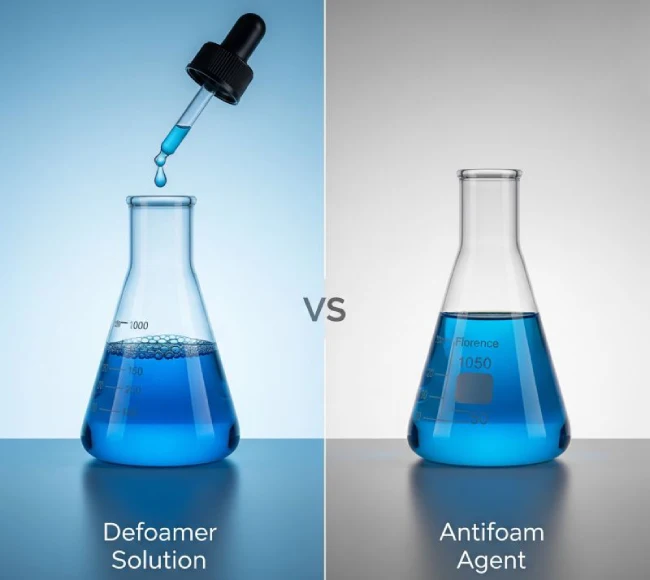
What Is an Antifoaming Agent?
An antifoaming agent (also called anti frothing agent) is a type of chemical additive with specific surface activity. Its main function is to intervene before or at the very early stage of foam formation. By altering the surface properties of a liquid system, antifoams prevent bubbles from developing into stable foam, achieving long-term and gentle foam control.
In short, the goal of an antifoam is to stop foam from forming in the first place or suppress its initial growth.
How Does Antifoam Work?
To understand how antifoams work, we first need to know how foam is formed. Foam is essentially gas trapped within a liquid film. Two conditions must be met:
1. Continuous gas dispersion, and
2. A liquid film strong enough to resist collapse.

Antifoaming agents disrupt these conditions through four core mechanisms:
1. Preventing gas molecules from clustering. Antifoams quickly attach themselves to the gas–liquid interface. By adjusting surface tension, antifoams make it harder for small gas bubbles to form, reducing the chance of foam at the source.
2. Destabilizing microbubbles. If small bubbles do appear, antifoams weaken their thin liquid film (like the skin of a balloon), causing them to collapse before they grow into visible foam.
3. Reducing available gas. Certain components in antifoams act like tiny sponges, absorbing free gas molecules in the liquid so fewer are available to form bubbles.
4. Neutralizing foam-stabilizing substances. Proteins or surfactants in liquid often “protect” bubbles. Antifoams either displace these stabilizers or break them down, leaving foam without support.
Through these steps, antifoams ensure foam is either never formed, or broken immediately. Unlike defoamers (which act after foam is already present), antifoams focus on prevention.
What is Defoamer?
While antifoaming agents act early, defoamers are applied after foam has already formed and stabilized.
Put simply, an antifoam is like a protective film on water, stopping bubbles from forming. A defoamer is like a “foam breaker” that penetrates existing bubbles and destroys them. The core goal of a defoamer is to eliminate existing foam quickly or disrupt its structure so it collapses.
How Does Defoamer Work?
Defoamers work by rapidly lowering local surface tension, destabilizing bubble walls, and causing foam to rupture or coalesce. This breaks down foam clusters and restores system balance.
Spreading Coefficient and Entry Coefficient
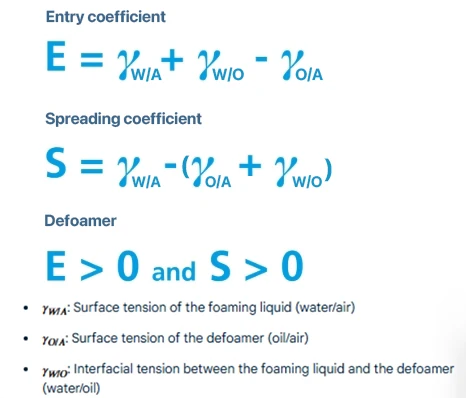
S = Spreading coefficient. It determines if the defoamer will spread rapidly across the surface of the foam lamella
E = Entry coefficient. It determines if the defoamer can penetrate the foam lamella in the first place.
When the spreading coefficient S > 0, the defoamer can spread over the foam liquid film; when the penetration coefficient E > 0, the defoamer can enter the foam film.
According to the American colloid chemist Ross, when the molecular group (i.e., droplet) of a defoamer comes into contact with the foam liquid film, penetration occurs first. After penetration, the droplet spreads over the foam film, causing local thinning of the film, which eventually ruptures, leading to bubble coalescence or collapse.
▪️ When S < 0 and E < 0, the droplets can neither penetrate nor spread.
▪️ When E > 0 and S < 0, the droplets can only penetrate the foam film but cannot spread, appearing in a prism-like form.
▪️ Only when E > 0 and S > 0 can the droplets both penetrate and spread over the foam film, thinning and rupturing it. In this case, the insoluble solute is defined as a defoamer.
For more information on how defoamers work, check it out here: Defoamer Mechanism | Easy to Understand
Types and Key Components of Defoamer and Antifoam:
Types of Defoamer and Antifoam:
Commercial antifoaming agents (defoamers) can generally be categorized into several main types: polyethers, fatty alcohols, silicone defoamers, non-silicone types, and mineral oil-based agents.
Key Components of Defoamer and Antifoam:
▪️Active ingredients: Silicone (e.g., polydimethylsiloxane), polyethers, oils, water-based systems, and hydrophobic particles (e.g., modified silica).
▪️Emulsifiers: Help disperse active ingredients evenly for higher efficiency.
▪️Carriers: Such as mineral oil or water, which improve stability and delivery of the active components.
The core components of defoamer and antifoam are usually hydrophobic particles (such as hydrophobic silica) and oleophobic liquids (such as silicone oil, mineral oil, or polyethers). These base materials inherently possess both foam-suppressing and foam-breaking capabilities.
The key difference between the defoamer and antifoam lies in the design emphasis: by adjusting the types, ratios, and particle sizes of the chemical components, engineers can enhance performance toward either foam inhibition or foam elimination.
Defoamer and Antifoam Applications & Industries
1. Wastewater Treatment
Foam buildup in aeration tanks can trigger shutdowns and block equipment. Defoamers/antifoams reduce foam, stabilize aeration, and lower energy use. Read more on causes of foaming in wastewater treatment.
2. Pulp & Paper
Control foam in pulping for better fiber distribution. Eliminate bubbles in coating stages to improve surface smoothness.
3. Textiles & Dyeing
Prevent color inconsistencies in dye baths and defects in desizing, bleaching, and finishing processes.
4. Paints, Coatings & Inks
Foam interferes with pigment dispersion and causes film defects. Defoamers keep coatings uniform and prevent pinholes or color variation. In inks, they improve print quality.
5. Oil & Gas
Control foam in drilling fluids and fracturing operations, ensuring smoother extraction processes.
6. Food & Fermentation (Food-grade Defoamers)
Used in fermentation (e.g., soy sauce, beer) and beverage production to control foam, preserve flavor, and maintain hygiene.
7. Pharmaceuticals
Prevent foam from affecting particle size and purity during drug formulation.
8. Metalworking & Electroplating
Reduce foam in cutting fluids and cleaning solutions. Ensure uniform plating without defects.
9. Chemical Manufacturing
Improve efficiency in reactions, mixing, and distillation. Used in petrochemical refining, rubber latex production, and other complex processes.
Defoamer and Antifoam Benefits & Value Proposition
✅ Boost Productivity: Prevent shutdowns and maintain continuous operations.
✅ Improve Product Quality: Avoid foam-related defects such as pinholes in coatings or bubbles in adhesives.
✅ Lower Costs: Reduce material waste, energy consumption, and maintenance expenses.
✅ Safe & Eco-friendly: Defoamers produced by formal manufacturers are non-toxic, heat- and alkali-resistant, and meet environmental standards.
✅ Versatile & Cost-effective: Suitable across industries from food to petrochemicals, delivering high efficiency.
✅ Support Special Processes: Effective even under extreme conditions (high temperature, strong alkali, fermentation environments).
In summary: Defoamers and antifoaming agents provide clear and measurable value — enhancing productivity, improving quality, lowering costs, and ensuring safe, sustainable production. They are indispensable aids in modern industrial and manufacturing processes.
Premium Defoamer and Antifoam Solutions from Your Trusted Supplier in China – Yuanwang Group
As a leading antifoam and defoamer supplier in China, Yuanwang prides of offering a comprehensive and versatile product portfolio designed to meet the precise needs of various industries. Our extensive range ensures that whatever your foam control challenge, we have the effective solution you require.
Our Product Line Overview:
✅ Fatty Alcohol Defoamer: Effective and versatile for many aqueous systems.
✅ Mineral Oil Defoamer: A cost-effective solution for widespread industrial use.
✅ Polyether Defoamer: Excellent performance in high-temperature and strong acid/alkali conditions.
✅ Silicone Defoamer: Highly efficient with persistent action for the most demanding applications.
Our defoamer and antifoam are all water based, and are available in various forms (liquid and powder) to ensure perfect compatibility with your specific process.

Your Partner for Performance and Reliability
With years of technical expertise and a commitment to innovation, we don’t just sell products, we provide solutions. We understand that every process is unique, which is why we offer customized defoamer formulations tailored to your exact requirements, ensuring optimal performance and cost-effectiveness.
Ready to Eliminate Your Foam Problems?
Contact us today to discuss your needs. Our technical experts are on hand to help you select the perfect product or develop a custom solution.
→ Request a Free Sample
→ Get a Professional Consultation
→ Inquire About a Custom Formulation
Reach out now to experience the difference that a truly reliable Chinese defoamer supplier can make!

Posted by Isabel leave words
Hi, I've been in this industry for five years. I hope you enjoyed my blog. Welcome to leave a comment down below.
Leave a Reply