
 Send Your Inquiry
The Overlooked Power of Dispersing Agents

Dispersing agents are everywhere in daily life. For example, when you make a cup of cocoa powder drink and just pour in hot water and stir, you’ll always find some little lumps of powder sticking together, either sinking or floating.
This happens because the cocoa powder particles “clump together,” and water alone can’t break them apart. But if you add a little dispersing agent (like a natural dispersing agent “lecithin”) into the water, the result changes.
One side of the dispersing agent holds the powder, the other side holds water. It separates the lumps, coats each particle with a protective layer, and stops them from sticking again. The cocoa powder then mixes evenly, no lumps, smooth to drink. — that’s the dispersing agent at work.
What is Dispersing Agent?
Dispersing agent, also called dispersants, is a surface-active substance. It reduces particle attraction, prevents clumping, and keeps solids evenly spread in liquid. This forms stable systems like suspensions, emulsions, and slurries.
To understand it simply: detergents carry oil and grease into water, emulsifiers mix immiscible liquids like oil and water, while dispersing agents keep solid particles evenly suspended in liquid.
Because of this unique function, dispersants are widely used in coatings, inks, ceramics, pharmaceuticals, food, and cosmetics. They play a key role in product stability, flow properties, and color performance.
Now that we’ve covered what dispersing agents are, let’s look at where and how they are applied.
Dispersing Agent Uses
Building and Construction Materials
Concrete: Water reducers or superplasticizers are the best-known use of dispersing agents in concrete. They attach to cement particles, push them apart, and break up clumps. This frees up trapped water, reduces water use, makes the mix flow better, and results in denser, stronger concrete.
Stucco: In plasters (such as wall plaster or tile adhesive mortar), water reducers or superplasticizers also improve particle distribution and workability. They are essential additives in modern high-performance building materials.
Paints, Inks, and Pigments
These are one of the most important fields for dispersants. The goal is to achieve uniform color, stability, and high gloss.
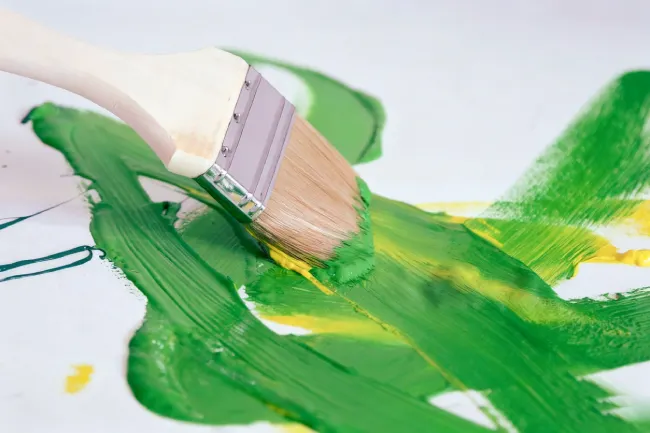
▪️Surface coating: Dispersants keep pigments and fillers evenly distributed. This improves gloss, color uniformity, durability, and creates a smooth film.
▪️Dispersing agent in paint: Prevents pigment flocculation and re-agglomeration. Enhances tinting strength and hiding power.
▪️Dispersing agent for water based paints: Improves wetting and coating of hydrophobic pigments (such as organic pigments). Keeps the system stable and prevents flocculation caused by electrolytes.
▪️Dispersing agent for pigments / carbon black / titanium dioxide: Carbon black and TiO₂ are the most common black and white pigments. Dispersants ensure full color development, strong hiding power, and maximum optical efficiency.
Textile
This use of dispersing agent in textile is key in modern synthetic fiber dyeing.
Dispersing agent in dyeing: Keeps hydrophobic disperse dyes evenly dispersed in the dye bath and prevents aggregation.
Dispersing agent for polyester dyeing: Works under high temperature and pressure to maintain stability. Ensures even dyeing, avoids shade differences, and improves fabric quality.

Petroleum and Chemical Industry
Oil drilling: Used to disperse clay and solids in drilling mud. Helps control rheology.
Oil spill: Used for offshore oil spills. Disperses oil into fine droplets, making it easier for microbes to degrade.
Detergents: Contain dispersants that break down grease and dirt into water, preventing redeposition on fabrics.
Plastics and Fillers
In plastics and rubber, dispersants help fillers spread evenly in the matrix, improving performance. Common fillers include talc and calcium carbonate.
Dispersing agent for talc: Reduces surface energy of talc layers. Prevents stacking and aggregation in polymers. Improves rigidity and dimensional stability.
Dispersing agent for calcium carbonate: Coats CaCO₃ particles, reduces van der Waals forces, and ensures uniform distribution. This enhances mechanical strength, whiteness, and surface gloss.
Pharmaceutical Industry
Dispersing agent in pharmaceutical: A key excipient to improve drug formulations. Ensures drug particles remain suspended, prevents sedimentation, and avoids clumping. This guarantees accurate dosage and safe administration.
Key Functions Of Dispersing Agents
1. Promote Wetting and Dispersion
They reduce the surface tension of the liquid so it can quickly penetrate and coat solid particles. This replaces the air on the particle surface and prepares for proper dispersion.
2. Prevent Particle Agglomeration and Sedimentation
This is the core function. Dispersing agents work in two ways:
– Electrostatic repulsion: give particles the same charge so they repel each other.
– Steric hindrance: use long polymer chains to form a physical barrier.
Ensure that dye particles are evenly dispersed during dyeing to prevent the formation of large particles or precipitation, guaranteeing that each fiber receives an equal amount of dye.
3. Improve System Performance and Efficiency
– Better color strength and hiding power: in paints and inks, dispersants separate pigment particles and maximize optical performance.
– Better rheology: lower viscosity and increase flow, making products easier to process and apply.
– Higher solid content: allow more solids to be added while keeping the same flowability, improving production efficiency.
4. Ensure Product Stability and Consistency
By maintaining a stable dispersion, dispersants prevent separation or sedimentation during storage and keep product quality consistent batch to batch.
5. Optimize Final Product Quality
They bring better gloss, uniformity, and mechanical strength (e.g., concrete) or higher bioavailability (e.g., pharmaceuticals), leading to an overall quality upgrade.
In summary, the function of a dispersing agent is a continuous process: start with wetting, then separation with mechanical energy, and finally stabilization. This improves both production efficiency and end-product performance.

Dispersing Agents Types
The following is classification by chemical structure, which is the most core classification method.
| Type | Feature | Pros | Cons | Examples |
| Anionic | Hydrophilic group is a negative ion in water | Good dispersing ability, low cost | Sensitive to pH, poor in acidic systems, not compatible with cationic additives | Polyacrylate, Lignosulfonates, Naphthalene sulfonate formaldehyde, Sodium oleate |
| Cationic | Hydrophilic group is a positive ion in water | Works well with negatively charged particles | Narrow use, high cost, may cause precipitation with anionic agents | Quaternary ammonium salts (CTAB), Amine derivatives |
| Nonionic | Does not ionize in water, neutral groups | Good compatibility, stable with pH and salts, low foam | Weaker dispersing effect, temperature sensitive | Polyethers (AEO, APEO), Esters (Span, Tween) |
| Amphoteric | Contains both anionic and cationic groups | Works in different pH, excellent compatibility | Complex structure, expensive | Betaines, Amino acid types |
| Polymeric Dispersing Agent | Has anchoring group + solvated chain | Very efficient, stable, small dosage, good for high solids | Higher cost, more complex | Acrylic dispersing agent, Polyester dispersing agent, Polyvinyl alcohol dispersing agent |
Case Study: Dispersing Agent Cementing Mud Chemicals
In oil and gas drilling and cementing operations, a water reducer is a high-performance dispersant. It helps disperse cement particles evenly, reduces slurry viscosity, and ensures good fluidity of the cement slurry while improving construction safety. Its application directly affects the quality of cementing.
| Generation | Typical Chemical Name | Chemical Type | Key Mechanism & Features |
| First Generation | Lignosulfonate-based water reducers (NSF), Sulfonated melamine formaldehyde water reducers (MSF) | Anionic polymeric dispersants | Mainly rely on strong electrostatic repulsion. Fast initial dispersion, but some loss of effectiveness over time. Simple structure and low cost, but performance is limited. |
| Second Generation | Polycarboxylate ether water reducers (PCE) | Anionic polymeric dispersants (Super dispersants) | Main mechanism is steric hindrance, assisted by electrostatic repulsion. Molecular structure can be designed for high water reduction and good slump retention. This is the current mainstream technology. |
| Third Generation | High-performance polycarboxylate-based water reducers | Anionic polymeric dispersants (Super dispersants) | Optimized structure based on second-generation PCE. Higher efficiency, better performance, and wider adaptability. Ideal for modern high-performance concrete and challenging conditions. |

China Dispersing Agent Supplier – WOTAlchem™
As a leading China-based supplier of high-performance cementing mud chemicals. WOTAlchem specializes in manufacturing advanced dispersing agents, with our polycarboxylate ether superplasticizers standing at the core.
These cutting-edge dispersants are engineered to dramatically enhance the fluidity and workability of cement slurries and drilling muds, ensuring superior dispersion of solid particles for optimal pumpability and wellbore stability.
If you need any solution or product, please feel free to contact our engineer. We are glad to help!
WhatsApp: +86 18553170666

Posted by Isabel leave words
Hi, I've been in this industry for five years. I hope you enjoyed my blog. Welcome to leave a comment down below.
Leave a Reply