
 Send Your Inquiry
Types of Cellulose Fiber: A Complete Guide
If you’ve ever browsed home textiles, or even looked into eco-friendly materials, you’ve probably come across the term CELLULOSE FIBER. But what exactly is it? Why is it everywhere? And with so many variations — cotton, linen, hydroxypropyl methyl cellulose…… What types of cellulose fibers are there?
What is cellulose fiber?
To understand what cellulose fiber is, we’d better to know what cellulose is first.
What is cellulose?
Cellulose is a chemical substance. It is the main component of plant cell walls. Chemically, it is a polysaccharide (a long chain composed of many glucose molecules).
Cellulose is the most abundant organic polymer on Earth. Its main function is to form the supporting tissue of plants. It allows trees, cotton, and straw to grow tall and strong within the plant body.

What is cellulose fiber?
Cellulose fiber is a fine and long fiber, made by further processing cellulose extracted from plants. It appears as fine filaments and has certain strength and softness. It has the following characteristics:
✅ Natural, renewable, degradable, and more environmentally friendly (green fiber)
✅ Skin-friendly, breathable, and moisture-absorbent (cotton and linen clothing)
✅ Anti-static
✅ Strength enhancement (when used as chemical materials)
Is cellulose a type of fiber?
The reason why cellulose and fiber are often confused is that, most cellulose is in a fibrous form, that is, long and thin, and we may easily regard it as fiber.
However, when the state of cellulose is no longer fibrous, such as degradation, dissolution and regeneration, etc., it does not conform to the definition of fiber, but only cellulose.
Meanwhile, the substances included in fibers are not just cellulose. There are hemicellulose, lignin, etc.
Therefore, strictly speaking, cellulose is not fiber.
What type of fiber is cellulose?
Cellolose is not a fiber but merely a component of fibers. Chemically speaking, cellulose is the main component of plant fibers / natural cellulose fibers.
Is cellulose a soluble fiber?
Cellulose, this chemical substance, is insoluble in its structural state. Only when it undergoes chemical degradation (such as being treated with strong acid) or is processed into specific derivatives (such as HPMC, MHEC, HEC, wood cellulose fiber, etc.) does it exhibit the solubility property. For example:
✅ The cellulose in the cotton shirt you are wearing is insoluble;
✅ When eating celery, the strands you can’t chew up are insoluble;
However, its derivatives, such as:
✅ The cellulose derivatives added to the beef balls in the hot pot you eat is soluble;
✅ The cellulose ethers in building materials (such as grouting) are soluble.

Is cotton cellulose fiber?
Cotton is a natural cellulose fiber. It has soft texture, excellent moisture absorption and warmth retention properties.
The cotton fibers of cotton, are mainly composed of cellulose, a polysaccharide formed by the polymerization of glucose monomers. The cellulose content of cotton fibers is nearly 100%, making it the purest natural source of cellulose.
Is silk cellulose fiber?
Cellulose fibers are mainly composed of cellulose polysaccharides derived from plants.
Silk, on the other hand, is mainly made from silk fibres. The silk fibres’ chemical composition is protein, including sericin protein (about 75%) and sericin protein (about 22.5%). It belongs to animal protein fibers, instead of plant cellulose fibers.
What is cellulose fiber in bread?
Cellulose fiber in bread is what we commonly refer to as dietary fiber. It is usually derived from wheat bran, whole wheat flour, oats, corn, and soybeans. Its functions are:
✅ Making the bread lighter and less prone to collapsing;
✅ Increasing the chewiness and extending the shelf life;
✅ Promoting intestinal peristalsis and promoting better health.
What is cellulose fiber in food?
If you have eaten celery, you might have experienced it’s hard to chew. That is cellulose fiber. It cannot be digested by the human body, but it can help clean the intestines and is very beneficial to the body.
Apart from celery, there are many other foods that contain a large amount of cellulose fiber (dietary fiber), such as:
✅ Apples and pears’ peels
✅ Citrus fruit’s fibrous pith
✅ The coarse particles in whole wheat bread
✅ Vegetables like broccoli, leeks, and shiitake mushrooms
✅ Oats, corn, and sweet potatoes
What are the benefits of it for the body?
It makes you feel fuller for longer, and causes a slower increase in blood sugar, which is suitable for controlling sugar levels and losing weight.

Types of cellulose fibers
Cellulose fibers are mainly divided into two categories: natural cellulose fibers (plant fibers) and regenerated cellulose fibers.
✅ Natural cellulose fibers (plant fibers): Obtained from plants, without chemical processing
✅ Regenerated cellulose fibers: Made from natural plant fibers through chemical methods for reformation

Natural Cellulose Fibers (Plant Fibers)
| Subclass | Main types | Source/Characteristics |
| Seed fiber | Cotton, ceiba | Derived directly from plants, it contains over 90% cellulose. It possesses natural moisture-absorbing and breathable properties. |
| Bast fiber | Flax, ramie, jute, hemp, Apocynum venetum | Extracted from the phloem part of plant stems, these fibers have high strength. For example, linen is cool to wear. |
| Leaf fiber | Sisal, banana hemp (Manila hemp), pineapple leaf fiber | Extracted from plant leaves or leaf sheaths, it has a firm texture and is mostly used for making ropes, industrial blankets, etc. |
| Fruit fiber | Coconut fibre | Derived from coconut fruits, it is rich in lignin and highly resistant to decay. It is often used to make mats, brushes, etc. |
| Others | Bamboo fiber, bagasse fiber | Natural fibers extracted directly from bamboo stalks or sugarcane residue. |
Regenerated Cellulose Fibre
These fibers are made from natural cellulose, such as wood, bamboo, and cotton lint through chemical processing. Therefore, they are also called artificial cellulose fibers.
They retain the advantages of plant fibers. Through subsequent processing adjustments, also adds properties that natural fibers do not originally possess.
For example, for cotton cellulose fibers, they have natural softness. However, when people need them to be smoother, the process can be customized to enhance its smoothness, strength, and wrinkle resistance.
| Common types | Main features |
| Viscose Fiber/Rayon | ▪️The most commonly used regenerated cellulose fiber. ▪️Also known as ice silk and artificial silk. ▪️It has good moisture absorption. ▪️However, it will become hard when exposed to water and the fabric loses its elasticity. |
| Modal | ▪️An upgraded version of common viscose fiber. ▪️The fabric is durable and has a soft hand feel. ▪️It is softer than cotton. ▪️It is very suitable for making undergarments and other close-fitting clothes. |
| Lyocell | ▪️The highest technological content, with the most balanced performance ▪️The flagship version of common viscose fiber. ▪️Its durability far exceeds that of ordinary Viscose Fiber and modal. ▪️More slippery than Modal ▪️It has a distinct cool sensation, very suitable for summer ▪️Higher price ▪️Excellent environmental protection performance and generates almost no pollutants |
| Cupro | ▪️Also known as artificial silk, it is often mentioned in the same breath as real silk ▪️Ultimate delicacy and skin-friendly feel ▪️It absorbs and releases moisture quickly ▪️It has an elegant luster similar to that of real silk ▪️It has an excellent drape ▪️Often used in high-end underwear and linings |
| Acetate / Triacetate | ▪️It has a luster like silk ▪️Excellent drape ▪️Not prone to deformation and almost does not require ironing ▪️The drying speed is very fast. ▪️Poor hygroscopicity, may be muggy in summer |
What is cellulose fiber used for?
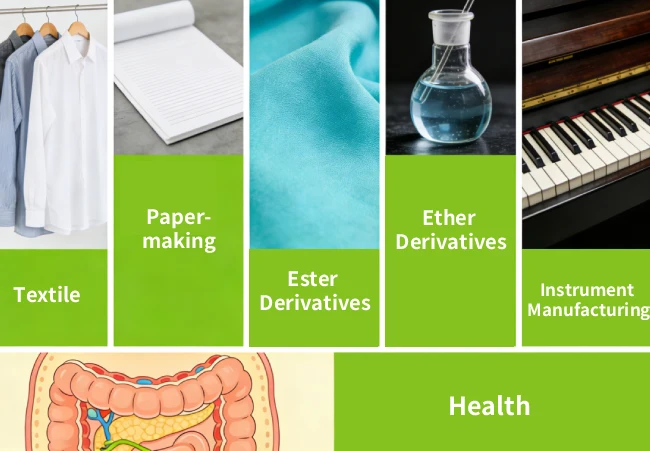
▪️Textile and Papermaking: Cellulose fibers used worldwide for textile (T-shirts, underwear, shirts, suit fabrics, and home textiles) and paper production amounts to 8 million tons annually.
▪️Ester Derivatives: Using separated and purified cellulose as raw material, artificial silk, cellulose nitrate, cellulose acetate, and other ester derivatives such as ether derivatives can be manufactured.
▪️Ether Derivatives: Methyl cellulose, ethyl cellulose, carboxymethyl cellulose, polyanionic cellulose PAC, etc. are ether derivatives used in construction, medicine, food and daily chemicals, etc.
▪️Instrument Manufacturing: Cellulose has excellent acoustic properties, and can be used to manufacture instruments such as pianos and violins.
▪️Health: The cellulose fiber in human diet has functions such as promoting intestinal peristalsis and facilitating the excretion of feces.
How to make cellulose fiber?
Cellulose fibers are mainly made by extracting natural cellulose and processing it.
✅ Natural cellulose fibers are directly collected without the need for chemical processes.
✅ Regenerating cellulose fibers requires a chemical spinning process.
For specific production methods, please refer to this BLOG: Cellulose Fiber Manufacturing Process Explained

Posted by Isabel leave words
Hi, I've been in this industry for five years. I hope you enjoyed my blog. Welcome to leave a comment down below.
Leave a Reply