
 Send Your Inquiry
Concrete Defoamer Functions: Benefits, Mechanism, and Applications
During the production and construction of concrete, foams are inevitably formed inside the concrete. The formation of these foam is mainly influenced by three factors:
1️⃣Firstly, the characteristics of raw materials. For example, air adsorption on the surface of cement particles, or excessive clay content in sand causing entrapped air at the interface.
2️⃣Secondly, the mixing process. The air is mechanically incorporated during high-speed mixing to form tiny bubbles.
3️⃣Thirdly, the effect of admixtures. Some water reducers, air-entraining agents, and other surface-active substances reduce the surface tension of the liquid, promoting the stable existence of foam.
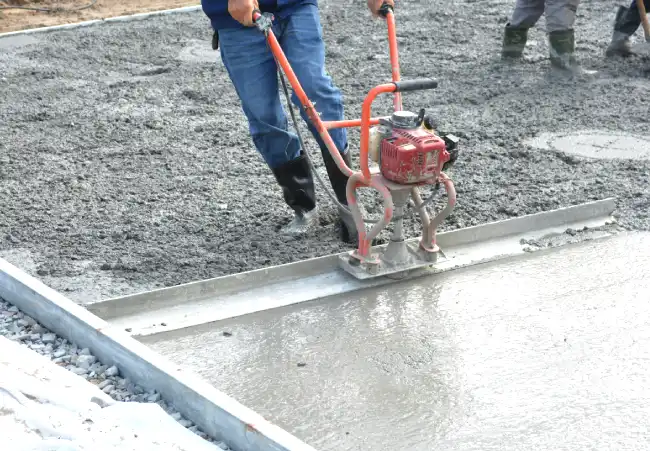
The Hazards of Foams in Concrete
Excessive foam can cause multi-dimensional damage to the performance of concrete.
▪️From the perspective of mechanical properties, large foam with a diameter over 0.3 millimeters will form stress concentration points, resulting in a 5%-15% decrease in the compressive strength of the concrete;
▪️From the durability aspect, interconnected foam will become channels for the penetration of erosion media such as water and chloride ions, causing the impermeability grade to decrease by 1-2 levels (for example, from P8 to P6);
▪️From the construction quality perspective, surface foam will form honeycomb-like defects, and a municipal road project once had an appearance acceptance rate of only 70% due to excessive surface foam, requiring additional repair costs.
Concrete Defoamer Action Mechanism
Concrete defoamer is a type of surfactant that can disrupt the stability of bubbles. Its core function is achieved through three steps:
- 1. The defoaming agent molecules rapidly penetrate the surface of the bubble liquid film, reducing the local surface tension.
- 2. It disrupts the elastic balance of the bubble film, causing the liquid film to become thinner until it reaches the critical thickness.
- 3. The liquid film ruptures, allowing the gas inside the bubbles to escape, thereby eliminating the excess bubbles.
Different Types of Concrete Defoamers Functions
- Organic silicon-based defoamers (mainly composed of polysiloxanes) have a fast defoaming speed, excellent performance in removing tiny bubbles, but are greatly affected by temperature (activity decreases below 5°C).
- Polyether-based defoamers (formed by copolymerization of ethylene oxide and propylene oxide) have good stability and high compatibility with cement slurry, suitable for concrete that requires long-term stirring.
- Mineral oil-based defoamers have a lower cost, but have relatively weak defoaming efficiency, and are mostly used for ordinary concrete where the control of bubbles is not highly required.

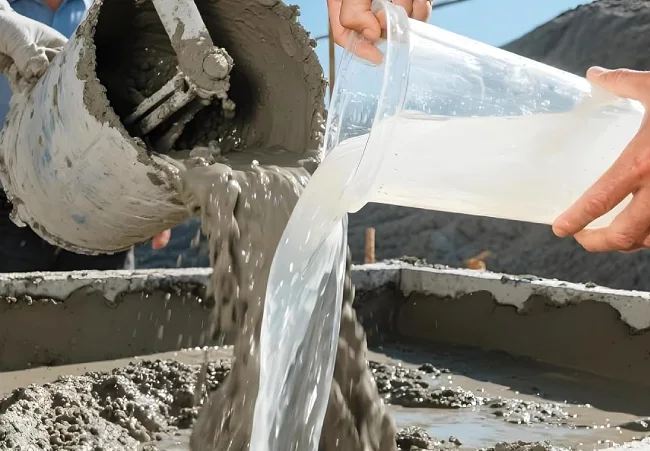
Advantages of Concrete Defoamers
1. Mechanical Performance Optimization
By eliminating harmful foam, defoamers can effectively enhance the compressive and flexural strength of concrete. Test data shows that under the same mix ratio, adding 0.03% of the defoamer (based on the total amount of the cementitious materials) have obviously advantages:
1) Can increase the 7-day compressive strength of the concrete by 8%-12%, and the 28-day compressive strength by 10%-15%;
2) The flexural strength also improves significantly, generally reaching 15%-20%. There’re great significance for structures such as road surfaces and bridge decks that bear bending and tensile stresses.
After being applied in a highway bridge deck paving project, the flexural strength of the concrete increased from the designed value of 5.0 megapascals to 5.8 megapascals, effectively extending the service life of the pavement.
2. Durability Enhancement
Defoamers significantly improve the impermeability and freeze resistance of concrete by reducing the number of interconnected pores. Impermeability tests show that:
1) The penetration height of concrete with defoamer is 40%-60% lower than that without defoamer;
2) The impermeability grade can be increased from P6 to P8 or even P10;
3) The number of freeze-thaw cycles (Grade D) can increase by more than 50 times (e.g., from D200 to D250).
After being used in a water conservancy project in the northern region, the concrete in the -20°C to 5°C alternating freeze-thaw environment, after 200 cycles, the quality loss rate was only 0.8% (compared to 2.5% without adding defoamer), effectively preventing freeze-thaw erosion.
3. Surface Quality Improvement
In the formwork engineering, defoamers can reduce the pores and honeycomb defects on the concrete surface. The measured data shows that after using defoamer, the number of pores within 0-20 millimeters of the concrete surface is reduced by 70%-80%, and the average diameter of the pores is reduced from 0.5 millimeters to below 0.1 millimeters.

In the construction of the side wall of a subway station, after using concrete with added defoamer, the proportion of honeycomb areas on the surface was reduced from the original 5% to 0.5%, eliminating the traditional grinding and repair procedures, and saving about 800 RMB in labor costs per 100 square meters.
Notes for Attention
1. Dosage Control
The antifoaming agent has an optimal dosage range, typically 0.01% to 0.05% of the total amount of the cementitious material. When the dosage is too low, it cannot effectively eliminate bubbles; when the dosage is too high (exceeding 0.1%), it may lead to excessive foaming, which can damage the beneficial micro-bubbles (with diameters of 0.05-0.2 millimeters that can enhance frost resistance) and instead reduce the durability.
A prefabricated component factory once mistakenly increased the dosage to 0.08%, resulting in a reduction of the concrete’s frost resistance grade from D250 to D200. It is recommended that when using for the first time, the optimal dosage can be determined through trial mixing: take three gradients of 0.01%, 0.03%, and 0.05% of the total cementitious material, and test the gas content, strength, and surface quality respectively. Select the dosage with the best comprehensive performance.
2. Compatibility with Other Additives
The antifoaming agent needs to be used in conjunction with other additives such as superplasticizers and air-entraining agents. If an air-entraining agent (used to introduce beneficial small bubbles) is used simultaneously, it is necessary to note that the antifoaming agent will partially counteract the air-entraining effect. At this time, the dosage of the air-entraining agent should be adjusted (usually increasing by 10%-20%), ensuring that the gas content is controlled within the design range (such as 4%-6% for frost-resistant concrete).
A concrete mixing station once failed to adjust the air-entraining agent dosage, resulting in a decrease in the concrete’s gas content from 5% to 3%, and the frost resistance performance not meeting the standards. Additionally, polycarboxylate water reducers and organic silicon antifoaming agents may react, causing a phenomenon of slurry stratification. It is recommended to use polyether antifoaming agents or conduct compatibility tests (mix the antifoaming agent and water reducer in proportion and observe whether there is precipitation or floating oil within 1 hour) before construction.
3. Construction Process Compatibility
The mixing time should be appropriately extended to ensure the uniform dispersion of the defoamer. The recommended mixing time for ordinary concrete is to extend by 10-20 seconds (total mixing time should be no less than 90 seconds), and for high-strength concrete (C50 and above), extend by 20-30 seconds. If the mixing time is insufficient, local enrichment of the defoamer may lead to excessive foaming, while local absence may result in incomplete bubble removal.
In terms of temperature control, organic silicon antifoaming agents have reduced activity below 5°C. It is recommended to use polyether antifoaming agents during winter construction, or conduct compatibility tests (mix the antifoaming agent and water reducer in proportion and observe whether there is precipitation or floating oil within 1 hour) before mixing to ensure the foaming effect.
4. Quality Inspection Key Points
During construction, it is necessary to focus on testing the gas content of the concrete (using an air pressure gas content tester, test once every 50 cubic meters). The target gas content should be 0.5%-1% lower than the design value (as the antifoaming agent will reduce some bubbles). At the same time, observe the distribution of surface pores after demolding.

The qualified standard is: on each square meter of the surface and above, the number of pores with a diameter greater than 0.3 millimeters should not exceed 5, and there should be no continuous groups of pores. If there are excessive pores, check the dosage of the antifoaming agent, mixing time, or compatibility of the additives, and make timely adjustments to the mix ratio.
Practical experience shows that the rational use of concrete antifoaming agents is an effective means to improve the comprehensive performance of concrete. By precisely controlling parameters and optimizing process compatibility, it is possible to achieve simultaneous improvement in strength, durability, and surface quality without significantly increasing costs (the cost of antifoaming agents accounts for 1%-3% of the total cost of concrete).
This is particularly suitable for prefabricated components with high appearance requirements, water engineering structures exposed to harsh environments, and bridges subjected to dynamic loads.

Posted by Isabel leave words
Hi, I've been in this industry for five years. I hope you enjoyed my blog. Welcome to leave a comment down below.
Leave a Reply