
 Send Your Inquiry
Concrete Road Pavement: Mix Ratio, Materials, and Step-by-Step Construction Guide
The quality of the concrete road pavement is closely related to the concrete mix ratio. It directly determines the bearing capacity and service life of the road surface. And construction technique is also a crucial part. If there are any oversights in the construction process, it may also cause early cracking of the ground.
WOTAIchem has many years of experience in concrete mix ratio. Engineer Stella Gao systematically optimized the mix ratio of concrete, from the perspectives of water-cement ratio and aggregate grading. This mix ratio can ensure the overall quality of the road project and enhance the durability of the concrete road pavement surface.
General Road Pavement Concrete Mix Ratio
In the construction of concrete for general road pavements, the following raw materials are selected first:
(1) Cement paste material, ordinary Portland cement is chosen;
(2) Coarse aggregate, crushed stones with a maximum particle size of ≤ 30 mm are selected, which are hard in texture and can enhance the compactness and strength of the concrete slurry;
(3) Fine aggregate, medium sand with a fineness modulus between 2.4 and 2.8 is selected, and its clay content is ≤ 3%;
(4) Additives, polycarboxylate-based high-performance water reducer is chosen to enhance the strength and durability of the concrete;
(5) Water
Then, based on the grade of general roads, traffic volume and design requirements, a detailed mix ratio design is carried out. According to the demand for cement concrete strength of general road pavements in China, the water-cement ratio is determined as follows:
Mix Design of Cement Concrete
| Material Name | Cement | Water | Coarse Aggregate | Fine Aggregate | Water Reducer |
|---|---|---|---|---|---|
| Mix Ratio | 2.17 | 1.00 | 6.57 | 3.89 | 0.026 |
Construction Technique of Ordinary Concrete Road Pavement
Mixing and transportation of cement concrete
Based on the above cement concrete mix design, use high-precision electronic measuring equipment, to accurately weigh various raw materials, and carry out the mixing of cement concrete. Adopt the feeding sequence of “sand – cement – water reducer – crushed stone – water”:
✅First, put the fine aggregate into the mixer and start the mixer for dry mixing for 12 seconds;
✅Then add cement and water reducer, continue dry mixing for 24 seconds to allow cement and water reducer to fully adhere to the surface of the sand; then add coarse aggregate, mix for 35 seconds to allow the coarse and fine aggregates to be preliminarily mixed evenly;
✅Finally, add water while mixing to make the slurry uniformly mixed, with a total time controlled at around 120 seconds.
This feeding sequence can avoid cement agglomeration, ensure the uniform dispersion of the water reducer, and improve the mixing quality of the concrete. After the mixing of the cement concrete slurry is completed, use an 8m³ concrete mixing and transportation vehicle to transport it to the construction site.
During transportation, to prevent concrete segregation and water evaporation, the transportation vehicle is equipped with an automatic mixing device, rotating the mixing drum at a speed of 3 r/min slowly to maintain the stability of the concrete temperature.
When the transportation vehicle arrives at the construction site, a dedicated person checks the slump, temperature, etc. of the concrete slurry. If the concrete quality does not meet the requirements, refuse to accept it and require it to be returned to the mixing station for processing. After the inspection is correct, proceed with the next process.
Concrete road pavement laying and vibration
After the concrete has passed the on-site acceptance inspection, it can enter the pavement laying construction stage. This mainly includes base treatment, template installation, reinforcement mesh laying, and laying and vibrating processes.
First, remove the floating soil, leaves and other debris from the surface of the road base, and clean it with a high-pressure water gun. Also, repair and remove the uneven areas to ensure the firmness and flatness of the base.
After the base treatment is completed, the template installation and reinforcement mesh laying can be carried out. These two processes are key to controlling the geometric dimensions and structural strength of the pavement. Specifically: Use steel templates with a height consistent with the design thickness of the concrete, and fix and install them on both sides of the road using steel struts, and apply a release agent on the inner side of the template to prevent the template from sticking and damaging the corners of the pavement.
After the installation of the templates and pre-treatment are completed, the reinforcement mesh is laid. Use Φ10 mm steel bars to bind into a reinforcement mesh, and complete the binding according to the dimensions and spacing shown in the figure.
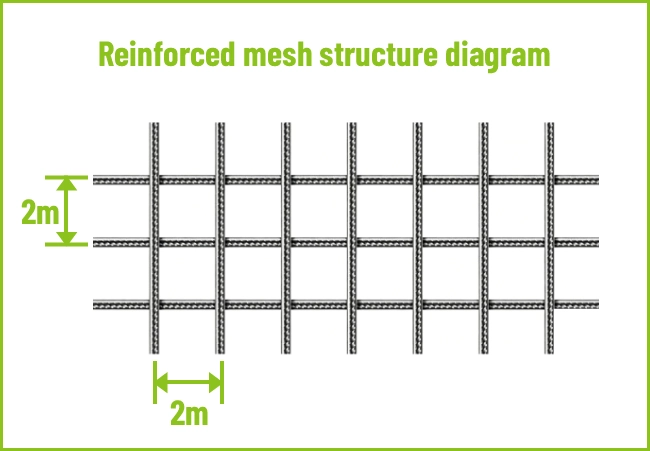
After the formwork and steel bars are arranged, all on-site preparations are finished, and the concrete paving construction starts immediately.
The paving and vibrating work is carried out by the leveling machine. When the machine moves forward, its vibrating shaft should be inserted about 15 cm into the concrete. The rotating shaft generates high-frequency vibration to compact the concrete. The vibration is finished and the concrete reaches good compaction when surface bubbles are mostly removed and the surface shows an even gloss.
After vibration compaction, the leveling machine smooths the concrete surface. Meanwhile, the vibrating shaft keeps running. High-frequency vibration makes cement slurry rise to the surface and form an even mortar layer, which further improves the surface smoothness and flatness.
Finally, check the flatness and compactness of the road concrete surface. If everything meets the requirements, wait for the concrete to set and harden, then remove the formwork.
Spray Curing of Concrete Road Pavement
To prevent early cracking of ordinary cement concrete pavement, timely curing is required after the concrete final sets.Spraying curing agent is an ideal method, which features fast film forming, even coverage and water saving.
The adopted curing agent is a diluted mixed emulsion of VAE and paraffin wax. It has excellent water retention performance with a water retention rate of over 95%, as well as good adhesion. It can effectively inhibit water evaporation of concrete and closely attach to the surface to form a continuous protective film.
During construction, a special sprayer with spraying system is used to spray the curing agent evenly on the concrete surface. This curing method maintains the internal humidity of concrete and reduces plastic shrinkage, so as to effectively prevent early cracks.The on-site construction schematic diagram is shown below:

WOTAIchem has been deeply engaged in the field of concrete admixtures for many years, focusing on the research and application of polymeric carboxylate high-performance water reducers, VAE, concrete fibers and other product series. It continuously optimizes the concrete mix ratio schemes for various engineering scenarios. Success stories
From raw material additives to process ratios, it provides full support, helping each road project achieve higher strength, better durability and lower cracking risks.

Posted by Isabel leave words
Hi, I've been in this industry for five years. I hope you enjoyed my blog. Welcome to leave a comment down below.
Leave a Reply