
 Send Your Inquiry
Fiber Tensile Strength: A Clear Comparison of Different Fiber Types
Choosing fiber materials with appropriate tensile strength can help you prevent material waste, save your costs, and ensure safe use. This article will help you understand the tensile strength of different fibers.
What is Fiber Tensile Strength?
The tensile strength of fibers is the fibers ability to resist breaking under tensile load. It is a core indicator for measuring the mechanical properties of fibers. It is also an important basis for material selection in various industries.
In our daily lives, the common units for measuring the tensile strength of fibers include cN/dtex, MPa, GPa, psi, etc.
The tensile strength of fibers can be classified according to strength grades as low strength (< 500 MPa), medium strength (500 – 1000 MPa), and high strength (> 1500 MPa).
Misconception: For a fiber, the longer it is stretched, the greater its tensile strength is.
Wrong. Tensile strength refers to the force required to break the fiber, not how long it can be stretched. Some fibers can be stretched for a long time before breaking, but this does not mean their tensile strength is high. A typical example is the aramid fibers. The aramid fibers are hardly stretched and have very little deformation, but they break only with a very large force. This proves that their tensile strength is very high.
Fiber Tensile Strength Test
Fiber Tensile Strength Test Method
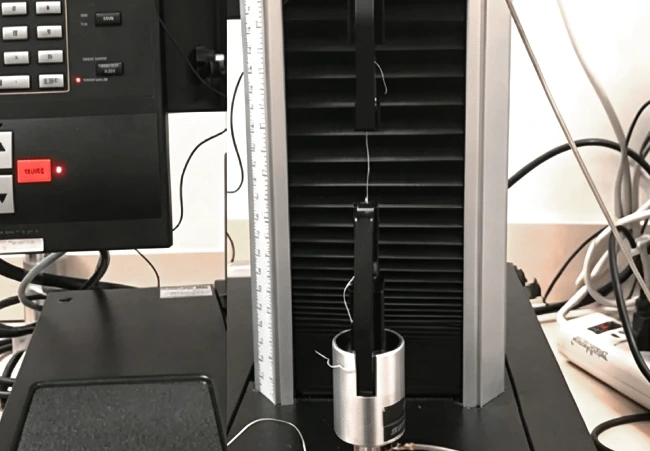
The fiber tensile strength test is mainly conducted by the constant elongation of a single fiber (CRE) method. The specific methods are as follows:
1) Clamp the single fibers on the tensile testing machine at specified intervals.
2) Continuously stretch at a set speed until they break.
3) Record the maximum force and elongation at break.
4) Convert into breaking strength or specific breaking strength.
The commonly used international standards for fiber tensile strength test mainly include ISO 5079, ASTM C1557 and ASTM D3822, etc. Different fibers require different standards. You can refer to the table below:
| Fiber Type | Preferred Standards |
|---|---|
| Cotton, hemp, bamboo, banana, bagasse (natural biomass single fiber) | ISO 5079 / ASTM D3822 |
| PET, PP, aramid (textile single fiber) | ISO 5079 / ASTM D3822 |
| Glass fiber yarn, basalt yarn | ISO 3341; ASTM C1557 (single filament) |
| Carbon fiber single filament | ASTM C1557‑20 |
| Carbon fiber filament tow | ISO 10618 / ASTM D4018 |
The above is the measurement method for a single fiber. For short fibers, measuring one by one is extremely time-consuming. Therefore, the single fiber constant elongation method (CRE) mentioned above is not applicable. In this case, the bundle fiber tensile strength test can be used. This testing method measures a large number of fibers at once. It uses a mathematical model to calculate the average tensile strength of the single fiber.
Except for the fiber tensile strength methods mentioned above, there are other testing methods:
1. Composite filament / yarn tensile test: This is for fibers with multiple filaments or yarns. The sample is stretched to obtain the tensile strength of the yarn.
2. Hooking strength test: This is suitable for natural fibers and synthetic fibers. Two fibers are hooked together and stretched until they break, measuring the hooking tensile strength. It reflects the bearing capacity of the fiber after bending.
3. Knot strength test: The fiber is knotted and stretched to measure the toughness of the single fiber after knotting and bending.
Fiber Tensile Strength Testing Precautions
1. The sample gauge length (holding length) has a significant impact on the test results: the shorter the gauge length, the higher the measured strength. Therefore, when conducting the test, the gauge length must be strictly fixed according to the standard. It cannot be changed randomly.
2. Natural plant fibers (sugarcane residue, banana fibers) have many defects. Their data fluctuates greatly. The standard requires testing a large number of samples for statistics.
3. For the same sample, use two sets of standards to test fiber tensile strengh, such as ISO5079 and ASTM D3822. The measured results will be slightly different due to different test requirements.
Tensile Strength of Different Fibers
Fibers are composed of millions of macromolecular chains. Different fibers have different tensile strengths. For example, the tensile strength of high-performance carbon fibers can reach over 4500 MPa, and that of aramid III long fibers can reach over 28.5 cN/dtex.
The factors influencing the tensile strength of fibers include: the arrangement of molecular chains, the strength of the chemical bonds in the molecules themselves, the length of the molecular chains, and the binding force between the chains. Among them, the arrangement of the molecular chains is a significant influencing factor.
When the molecular chains are arranged in a relatively orderly manner, more chains will share the tensile force together, and the tensile strength of the fiber will be higher; when the molecular chains are arranged chaotically, when subjected to force, only a few chains will bear the tensile force, and the strength will decrease.
In addition, the strength of the chemical bonds in the molecules themselves, the length of the molecular chains, the binding force between the chains, as well as the tiny cracks and defects within the fiber, can also change the tensile strength. The following table shows the tensile strength range of each fiber type.
| Fiber Type | Tensile Strength (MPa) |
|---|---|
| Carbon Fiber | 3500‑5000 |
| Carbon Fiber Composite | 1500‑2200 |
| Glass Fiber(E‑glass) | 2000‑2600 |
| Aramid Fiber(Kevlar) | 2700‑3400 |
| Basalt Fiber | 2800‑3500 |
| Steel Fiber | 1000‑1700 |
| PP Fiber | 300‑600 |
| Polyester Fiber(PET) | 400‑800 |
| Bamboo Fiber | 140‑600 |
| Hemp Fiber | 270‑900 |
| Banana Fiber | 300‑800 |
| Cotton Fiber | 280‑600 |
| Sugarcane Bagasse Fiber | 200‑300 |
| Optical Fiber | 3000‑5000 |
| Uhmwpe Dyneema Fiber | 3000‑4000 |
| Boron Fiber | 3000‑4000 |
| Zylon Pbo Fiber | 5200‑5800 |
Why is the tensile strength of the fiber a range rather than a single fixed value?
The same type of fiber can also be divided into different models, such as standard type, high-strength type, and ultra-high-strength type. Moreover, manufacturers can also artificially adjust the tensile strength of the fibers through processes, so only specific models will have a fixed tensile strength value.

*The table uses the median value of the tensile strength range for each fiber type.
Comparing the Tensile Strength of Different Fibers
The strength of different fibers varies significantly. Their differences make them suitable for different applications.
The following comparisons examine the tensile strength and key characteristics of several common fiber types. It will help you choose the right material for your application.
1. Carbon Fiber vs Fiberglass Tensile Strength
| Material | Tensile Strength (MPa) | Density (g/cm³) | Elastic Modulus (GPa) | Elongation at Break (%) | Key Characteristics |
|---|---|---|---|---|---|
| Carbon Fiber (T300 grade) | 3500‑4300 | 1.76 | 230‑240 | 1.5‑2.0 | High modulus with the lightest weight; features brittle, high strength only along fiber direction, poor compression resistance; high cost, electrically conductive |
| E‑Glass Fiber | 2000‑2600 | 2.54 | 70‑73 | 4.5‑5.0 | Low cost; large elongation; poor alkali resistance, insulating, brittle fiber |
2. Basalt Fiber vs Carbon Fiber Tensile Strength
| Material | Tensile Strength (MPa) | Density (g/cm³) | Elastic Modulus (GPa) | Elongation at Break (%) | Key Characteristics |
|---|---|---|---|---|---|
| Carbon Fiber (T300 grade) | 3500‑4300 | 1.76 | 230‑240 | 1.5‑2.0 | High modulus, lightest weight; brittle, high strength only along fiber direction, poor compression resistance; high cost, electrically conductive |
| Basalt Fiber | 2800‑3500 | 2.63‑2.7 | 85‑100 | 2.8‑3.3 | Properties are between glass fiber and carbon fiber; temperature‑resistant and corrosion‑resistant, insulating; lower cost than carbon fiber, with high brittleness |
3. Polyester (PET) vs Polypropylene (PP) Tensile Strength
| Material | Tensile Strength (MPa) | Density (g/cm³) | Elastic Modulus (GPa) | Elongation at Break (%) | Key Characteristics |
|---|---|---|---|---|---|
| Polyester (PET) | 400‑800 | 1.38 | 8‑14 | 10‑25 | It is stronger, better heat‑resistant and UV‑resistant; generally better tensile strength, wear resistance and creep resistance, not easy to stretch and deform |
| Polypropylene (PP) | 300‑600 | 0.91 (lighter, floatable in water) | 4‑8 | 15‑30 | It is lighter, better water‑resistance, superior chemical resistance, lower cost (WOTAIchem’s PP fiber tensile strength is up to 600MPa, check the TDS.) |
The Highest Tensile Strength Fiber
Which fiber has highest tensile strength?
PBO (poly(p-phenylene-2,6-benzobisoxazole)) is currently the strongest organic fiber in terms of tensile strength among high-performance organic fibers. Its typical monofilament tensile strength is approximately 5.8 GPa. It is followed by T800-grade carbon fiber and UHMWPE (Dyneema).
PBO is a synthetic organic super fiber. A single thin PBO filament can support extremely heavy loads. Its advantages include:
1. Exceptional tensile strength and high heat resistance. It is difficult to burn through when exposed to fire;
2. Extremely lightweight, significantly lighter than steel;
3. Wide range of applications, including bulletproof vests, explosion-resistant ropes, aerospace, and motorsports.
However, it also has drawbacks:
1. Sensitive to light and ultraviolet radiation. Prolonged exposure to direct sunlight damages the internal molecular structure, drastically reducing strength and causing brittleness. Therefore, it cannot be used exposed outdoors and must be protected with coatings or resin encapsulation.
2. Very expensive. It is primarily used in the high-end protective equipment and aerospace applications.
Does Higher Tensile Strength Mean Better Fiber Performance?
Incorrect.
Tensile strength is just one single mechanical property. It only indicates a fiber’s ability to resist breaking under tension or pulling. Keep in mind, it cannot determine the overall performance of a fiber. It also cannot be directly equated with superior comprehensive performance.
High tensile strength is a significant advantage of fibers. However, when use it practically, don’t just rely on the tensile resistance. A fiber’s true value is determined with multiple factors, including toughness, weather resistance, corrosion resistance, heat resistance, stability, and suitability for specific applications. Even high-strength fibers may have notable shortcomings.
Consider a typical example, in concrete applications, polyester (PET) fibers exhibit higher tensile strength than polypropylene (PP) fibers. You may take PET’s higher performance for granted. Yet you overlook PP fibers’ excellent alkali resistance. Actually, PP fibers are far more stable than PET fibers, which are prone to alkaline hydrolysis. This makes them more valuable as a concrete fiber additive.
Therefore, when you purchase fibers, do not evaluate their performance based on a single strength metric alone. Instead, consider a combination of tensile strength, alkali resistance, interfacial bonding capability, and long-term durability. Only fibers suited to your specific application are the best.
How to Choose the Right Fiber for Your Application?
Choosing a fiber based on tensile strength alone can be misleading. The right way is to consider the specific application and its required combination of tensile strength, alkali resistance, bonding performance, durability, chemical resistance, and other properties.
At WOTAIchem, we offer different types of fiber materials for concrete reinforcement and other applications, including PP fiber, PET fiber, PVA fiber, PAN fiber, wood cellulose fiber and other customized fiber solutions. Our premium PVA fibers are trusted by Sika and other leading construction material companies.
To avoid paying for unnecessary performance, you should match fiber type and performance requirements to the actual application. In this way, the required reinforcement and durability can be ensured.

The best fiber is not necessarily the one with the highest tensile strength—it is the one that provides the right balance of performance, durability, and cost for your application.
If you have difficulty in slecting the proper fiber, connect with us and our team is glad to help you!

Posted by Isabel leave words
Hi, I've been in this industry for five years. I hope you enjoyed my blog. Welcome to leave a comment down below.
Leave a Reply