
 Send Your Inquiry
Why Epoxy Conductive Putty is a Must for Your Electronics Project?
Epoxy conductive putty is essential for achieving reliable electrical conductivity and surface smoothness in industrial applications. It not only fills surface defects but also provides anti-static protection and enhances coating performance.
In this article, we explore why epoxy conductive putty is a must-have for your electronics project and how it helps improve both functionality and durability.

Function and Benefits of Conductive Putty
Epoxy conductive putty plays a vital role in surface preparation and performance enhancement. Here’s how it works and why it’s essential in various applications:
🔹 Fills Surface Defects in Industrial Components
Epoxy conductive putty has low volume resistivity and anti-static properties. It is mainly used to repair pits, cracks, and weld seams in parts that require electrical performance.
🔹 Ensures a Smooth Base for Anti-Static Coatings
One key function is to level the surface before applying anti-static topcoats. It’s also used for repairing anti-static floors and walls. In electrostatic powder coating, applying conductive putty before spraying greatly improves coating quality.
🔹 Creates a Flawless Surface for High-Performance Coatings
Powder coating doesn’t use a primer, so the surface must be smooth. Metal parts often have dents or scratches. Conductive putty fills these flaws to ensure a uniform, high-performance finish.
🔹 Supports Efficient, Cost-Effective Powder Coating
Powder coating is efficient, affordable, and Eco-friendly. It also offers strong corrosion resistance, insulation, and decorative appeal. Conductive putty ensures a defect-free base, essential for achieving these benefits.

What Is Conducting Putty Made Of?
Conductive epoxy putty is usually a two-component system. One part includes film-forming resin (such as E-20 epoxy), pigments, conductive filler, additives, and solvents. The other part is a curing agent.
Among these, only the conductive filler is different from regular epoxy putty. All other ingredients are similar to those used in standard epoxy putties.
Does epoxy putty conduct electricity? No, pure epoxy resin is not conductive. However, when mixed with conductive fillers, the putty becomes conductive. Common fillers include metal powder, silver, copper, and carbon. The conductivity depends on the type and amount of filler. More filler usually means better conductivity. After curing, the putty forms a conductive path. This gives it both anti-static and conductive properties.

Conductive Fillers
Conductive fillers fall into four types:
🔘Metal-based (Metal type)
🔘Carbon-based (Carbon type)
🔘Metal oxide-based (Metal oxide type)
🔘Composite types
The following table shows typical conductive fillers and their properties.
| Type | Filler Name | Conductive Putty Resistivity (Ω·cm) | Key Properties |
|
Metal-based | Silver powder | 1.6×10⁻⁶ | Excellent chemical stability, strong corrosion resistance, best conductivity, very expensive, mainly used in military or special applications. |
| Copper-based | 1.7×10⁻⁶ | Good conductivity, low cost, easy to oxidize. Conductivity is unstable, usually needs surface treatment for stable performance. | |
| Nickel powder | 1.0×10⁻³ | Moderate conductivity, widely used, good chemical stability, corrosion resistance, magnetic. | |
| Aluminum powder | 2.7×10⁻⁶ | Good conductivity, low cost, but prone to oxidation. Unstable conductivity and poor chemical resistance. | |
| Carbon-based | Carbon black, graphite | 1×10⁻² | Low cost, low density, good corrosion resistance. Poor conductivity, mainly used in anti-static applications. |
| Metal Oxides | Tin oxide, antimony oxide, zinc oxide | Varies greatly depending on metal oxides | Low conductivity, relatively stable in air. Can be used in transparent materials and anti-static coatings. |
| Composite types | Conductive carbon black, conductive glass fiber, conductive titanium dioxide, etc. | Varies within a certain range | Good overall performance, reasonable price, adjustable conductivity and color, widely available materials. |
Composite conductive fillers include composite powders and composite fibers. Using composite fillers in conductive coatings can reduce cost and improve performance.
Composite Powders
According to ISO 3252, composite powder is defined as powder where each particle is made of two or more materials. The particle size must be at least 0.5 μm to show distinct physical properties.
Metal-coated composite powder is made by coating metal onto the surface of core particles. These powders combine the advantages of both the coating metal and the core material.
Depending on the core, they can be divided into three types:
🔘Metal–metal
🔘Metal–non-metal
🔘Metal–ceramic
Examples include:
🔘 Silver-coated glass beads
🔘 Silver-coated copper powder
🔘 Silver-coated mica powder
🔘 Nickel-coated carbon black
There are also micro-powders with a metal oxide shell and a core made of silicon, silicides, or TiO₂.
Composite Fibers
There are many types of composite fibers. Examples include nylon, glass fibers, or carbon fibers coated with metal or metal oxides.
For example:
– Polyacrylonitrile (PAN) fiber coated with Cu or Ni
– Copper core coated with nickel, which prevents oxidation and keeps stable conductivity
Using electroless plating, metal layers can be deposited on glass fibers. These conductive glass fibers are used in anti-static coatings as composite fillers.

Basic Conductive Putty Recipe
The production of epoxy conductive putty involves two parts as below. Each part is made separately, then mixed in a fixed ratio before use.
🔘 The putty component
🔘 The curing agent component
The table below shows a typical reference formula for epoxy conductive putty:
| Components | Material Name | Function or Role | Dosage / Parts by Weight |
|
| E-20 epoxy resin | Film-forming material | 35–45 |
| Dispersant | Additive | 0.5–1.0 | |
| Solvent | Solvent | 40–50 | |
| Composite conductive filler | Functional filler | 8–12 | |
| Defoamer | Additive | 0.3–0.5 | |
| Cellulose ether | Thickener, improves viscosity and thixotropy | 0.3–0.5 | |
| Redispersible polymer powder | Additive, enhances strength and flexibility | 0.3–0.5 | |
| Zinc oxide powders | Filler, improves wear resistance and adhesion | 3–5 | |
| Zinc stearate | Improves wear resistance | 3–5 | |
| Organic bentonite pre-gel | Conductive filler, improves thixotropy | As needed | |
| Curing Agent Component | Polyamide curing agents | Curing agent | 55–60 |
| Compatible solvent | Solvent | 40–45 |
How to Make Conductive Putty?
Preparing the Putty Component
1. Add E-51 epoxy resin, dispersant, and part of the solvent into a kneader.
2. Mix thoroughly.
3. Add zinc oxide and zinc stearate.
4. Stir until fully dispersed into a uniform slurry.
5. Grind the slurry in a milling machine until the fineness is below 30 μm.
6. Add composite conductive filler.
7. Continue dispersing for 30 minutes.
8. Add the remaining solvent and other additives (like pre-gelled organoclay, cellulose ether, redispersible latex powder, and defoamer).
9. Stir until uniform.
10. The epoxy conductive putty is now ready.
Preparing the Curing Agent Component
1. Add polyamide curing agent and mixed solvent into a mixing tank.
2. Stir well to get a uniform liquid.
3. Fill the mixture into plastic soft tubes using a filling machine.
4. This forms the curing agent part of the putty.
Finally, package both parts together. Include clear instructions showing the mixing ratio by weight.
Performance Requirements of Epoxy Conductive Putty
Epoxy conductive putty for metal surfaces should have the characteristics below:
🔘 Strong adhesion
🔘 Good hardness
🔘 Resistance to cracking under heat
🔘 Anti-static and weldable properties
🔘 Fast drying at room temperature
🔘 High-temperature resistance
🔘 Easy sanding and application
Technical specifications are shown in the Table below.
| Item | Technical Specification |
| Condition in Container | No crust, no lumps, no visible granular aggregation; uniform paste |
| Weight Loss (120°C/1h) / % ≥ | 60 |
| Putty Color and Appearance | Gray, smooth, uniform, no cracks after drying |
| Dry Time (hard dry, 25°C) ≤ | 2 |
| Thickness / cm | 8~11 |
| Gelation Time (Workable Time) / min ≤ | 8 |
| Adhesion Strength (kgf/cm²) ≥ | 50 |
| Flexibility / mm ≤ | 100 |
| Impact Resistance / kgf·cm ≥ | 15 |
| Sandability (20 times) | Easy to sand, does not clog sandpaper |
| High-Temperature Resistance (220°C ±5°C, 0.5 h) | 1 mm thick layer: no cracking, no peeling, no bubbling |
| Cold-Heat Cycle Resistance (1 cycle) | No change |
| Dielectric Constant / Ω⁻¹ | 10⁻¹² ~ 10⁻⁶ |
Note: 1kgf = 9.80665N
High Amperage Electrically Conductive Putty
For high-amperage epoxy conductive putty, more strict requirements apply.
🔘 In addition to the basic properties, it must have very low resistivity.
🔘 The surface resistivity should be ≤ 10² Ω to ensure stable high current flow.
🔘 The current-carrying capacity should be ≥ 50 A.
🔘 It must also withstand short-term overload, handling sudden current spikes of several thousand amps without failure.
To achieve this, a high ratio of metal fillers like copper or silver powder is added. Thermal conductive additives are also included to improve heat dissipation. Thermal conductivity should be ≥ 1.5 W/(m·K), preventing overheating and material damage caused by Joule heat.
Application of Epoxy Conductive Putty
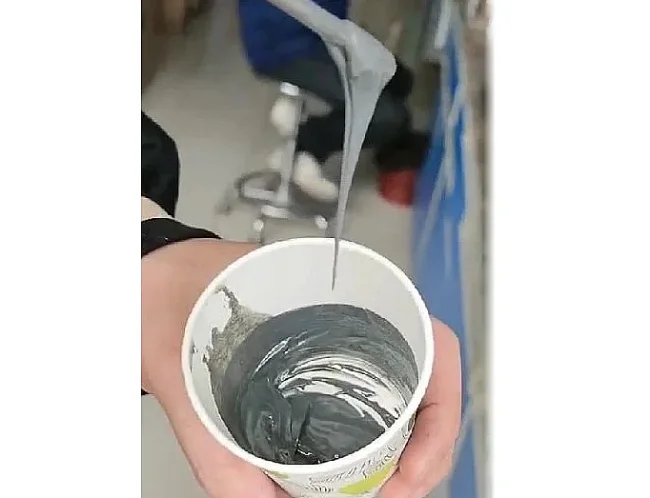
(1) Mixing:
▪️Mix the putty and curing agent evenly by the recommended ratio.
▪️The color must be uniform.
▪️Use the mixture within the gel time.
▪️Once it thickens or gels, it cannot be used.
(2) How to Keep Thickness of Conducting Putty?
▪️Before applying the putty, sand the substrate surface.
▪️If a thick putty layer is needed, apply it in several thin coats.
▪️Each coat should be leveled carefully to remove air bubbles.
(3) Thinning the Putty:
If thinning is needed, only use the designated thinner. Do not use general-purpose thinners like “banana oil” (toluene-based). Otherwise, problems like bubbling, peeling, and poor adhesion may occur.
(4) Curing Conditions:
In low temperature or high humidity, curing time will be longer.
High-Performance Additives for Epoxy Conductive Putty – From WOTAIchem™

To enhance the performance and stability of epoxy conductive putty, WOTAIchem offers a range of high-quality functional additives. These additives are widely used to optimize workability, durability, and electrical performance in demanding applications.
Here are some recommended additives and their roles in epoxy conductive putty:
✅Cellulose Ether: Improves thixotropy and workability. Helps the putty maintain shape during application and reduces sagging.
✅Redispersible Polymer Powder (RDP): Enhances flexibility, adhesion, and crack resistance after curing. It also improves the mechanical strength of the putty.
✅PAN Fiber (Polyacrylonitrile Fiber): Increases structural reinforcement and conductivity when coated with metals like Cu or Ni. Provides dimensional stability and crack resistance.
✅Defoamer: Eliminates trapped air bubbles during mixing and application. Ensures a smooth finish and better conductivity.
✅ Other putty chemical additives: HPMC (Hydroxypropyl Methyl Cellulose), MHEC (Methyl Hydroxyethyl Cellulose), HPS (Starch Ether), etc.
WOTAIchem is committed to supporting your formulation needs with reliable supply and expert technical advice.
📩 Got a question or need a custom recommendation?
Feel free to contact our team anytime — we reply within 24 hours!
📲WhatsApp: +86 18560052659
✅WeChat: +86 18553170666
✉️Email: [email protected]
Let WOTAIchem™ be your trusted partner in high-performance conductive putty solutions!

Posted by Isabel leave words
Hi, I've been in this industry for five years. I hope you enjoyed my blog. Welcome to leave a comment down below.
Leave a Reply