
 Send Your Inquiry
Is It OK to Pour Concrete in the Rain? Expert Tips and Precautions
The planned concrete pouring was already arranged, but suddenly it started raining. Can the work continue? Especially for large-volume concrete, if it stops due to rain, there will be significant losses. Large-scale pours at sites like nuclear or industrial plants typically involve coordinated use of overhead cranes for moving formwork, reinforcement cages, and concrete buckets — stopping mid-pour disrupts the entire lifting and placement sequence.Is it ok to pour concrete in the rain?
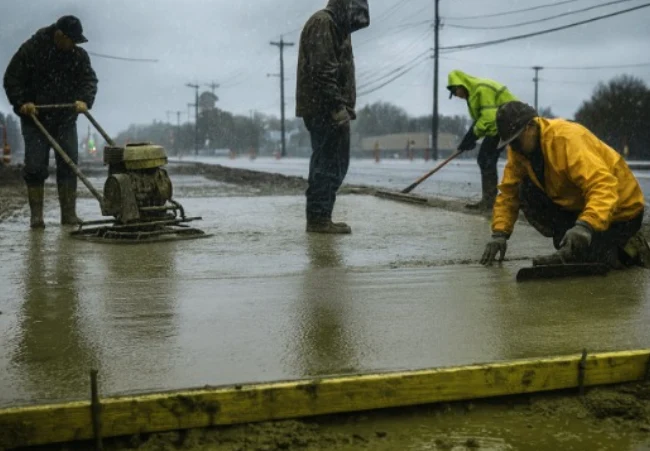
Based on the actual engineering data of large-volume concrete in the nuclear power plant, WOTAIchem will show you whether it is possible to pour under rainy conditions, how to do it, and what precautions to take.
Can You Pour Concrete in Light Rain? Engineering Examples
The average precipitation around the nuclear power plant project is 20mm, and the rainfall per unit area is about 20kg/㎡, which is the 24-hour rainfall. Considering the general pouring speed on site and the time it takes for two layers of concrete to cover the first layer, the estimated rainfall per unit pouring area is about 5kg/㎡.
Due to the small amount of rain, the erosion force on the concrete surface is weak, and the internal structure of the concrete is dense, so it basically does not enter the concrete. Since concrete pouring usually adopts inclined layer-by-layer pouring, during the pouring process, the rainwater will flow down along the slope.
Comprehensive analysis, combined with on-site construction protection measures, the amount of rainwater that can enter the concrete is 2.5% of the rainfall, that is, 0.5kg/㎡, which is equivalent to adding 500g of water per cubic meter of concrete, and has little impact on the quality of the concrete.

Further experiments show:
Adding 7.38kg of water per cubic meter of concrete, the water-cement ratio only increases by 0.02;
The 56-day compressive strength still reaches 43.8MPa, meeting the design requirements of 125%;
The strength is sufficient, and the structural safety is completely controllable under light rain conditions
From the actual engineering and test data, under light rain conditions, with proper protection and adjustment of the mix ratio, concrete can be poured normally, and it has little impact on strength, durability, and appearance.
However, if it is in heavy rain or rainstorm, it must be immediately stopped from pouring, and proper rain protection and construction joint treatment must be done. Absolutely do not force the construction.
3 Impacts of Pouring Concrete on Rainy Days
1. Strength
As shown in the above figure, the designed strength is 35 MPa, while the actual 28-day strength of the test blocks fluctuates around 50 MPa, and the 56-day strength fluctuates around 60 MPa. The strength margin is very large. Therefore, even if there is a certain amount of rainfall during normal large-volume pouring construction, it can still meet the strength requirements.
2. Durability: Meets the requirements
The durability of concrete mainly concerns the shrinkage and impermeability of the concrete. The shrinkage and impermeability of the concrete are mainly guaranteed by the design of the dosage of the cementitious materials, the unit water consumption, and the water-cement ratio.
By using a polycarboxylate high-performance water reducer, the unit water consumption of the concrete is greatly reduced, and the reduction of the unit water consumption is very beneficial to the durability of the concrete, which can reduce shrinkage and make the interior of the concrete more dense, thereby improving the impermeability of the concrete.
Under the condition of adding 7.38 kg of water per cubic meter of concrete in the rain, the water-cement ratio of the concrete increases by 0.02, and the durability of the concrete can also meet the requirements.
3. Appearance Quality
The appearance quality of concrete mainly refers to the situation where there is no serious segregation or bleeding during the pouring process. Under the condition of controllable rain intensity, the concrete should be poured. Since the lower layer of concrete is vibrated and compacted, the rainwater generally cannot enter the interior of the concrete, but only on the surface.
The concrete pouring should be carried out in a slanting layer, and during the pouring process, most of the water on the surface can be driven away. As long as the protection measures are in place, the lower layer of concrete is covered in time, and the accumulated water is removed, generally, it will not have a significant impact on the appearance quality of the concrete.
8 Quality Control Measures
To ensure safe pouring on rainy days, these 8 quality control measures must be implemented.
Rainfall will bring unnecessary troubles to the production and pouring of concrete, and may cause adverse consequences to the appearance, workability, strength, long-term performance, and durability of the concrete. Therefore, certain effective quality control measures need to be taken to ensure that the various properties of the concrete meet the construction requirements.
Specific quality control measures are as follows:
1. Before the production and pouring of concrete, timely grasp the weather conditions during the construction period and try to avoid pouring on rainy days;
2. A rain day concrete pouring construction plan should be compiled, detailed instructions should be given to the construction operators, and supervision should be carried out to ensure their strict implementation;

3. Increase the frequency of measuring the moisture content of sand, stone aggregates, and the slump of the concrete mixture, adjust the mix ratio in time, and appropriately reduce the slump of the concrete mixture to avoid excessive slumping that causes segregation of the concrete, ensuring the quality of the concrete;
4. Prepare sufficient rain-proof cloth on the site, cover the surface of the poured concrete in time, to avoid the concrete surface being washed by rain, resulting in the loss of cement slurry;
5. For beam and slab concrete pouring, a rain shelter should be erected. When encountering heavy rain or heavy rainstorm, construction should be stopped, and the construction joint should be treated;
6. Take effective drainage measures, such as configuring an suction pump to pump water, not letting the concrete mixture be soaked in water, and not letting the drained rainwater carry away the cement slurry of the concrete;
7. Before discharging the material from the concrete mixer truck, the rainwater in the hopper should be discharged, and then the material should be discharged to avoid mixing rainwater into the concrete.
8. Make records, study and summarize the problems that occur in the concrete, and provide references for similar situations in the future.

Posted by Isabel leave words
Hi, I've been in this industry for five years. I hope you enjoyed my blog. Welcome to leave a comment down below.
Leave a Reply